

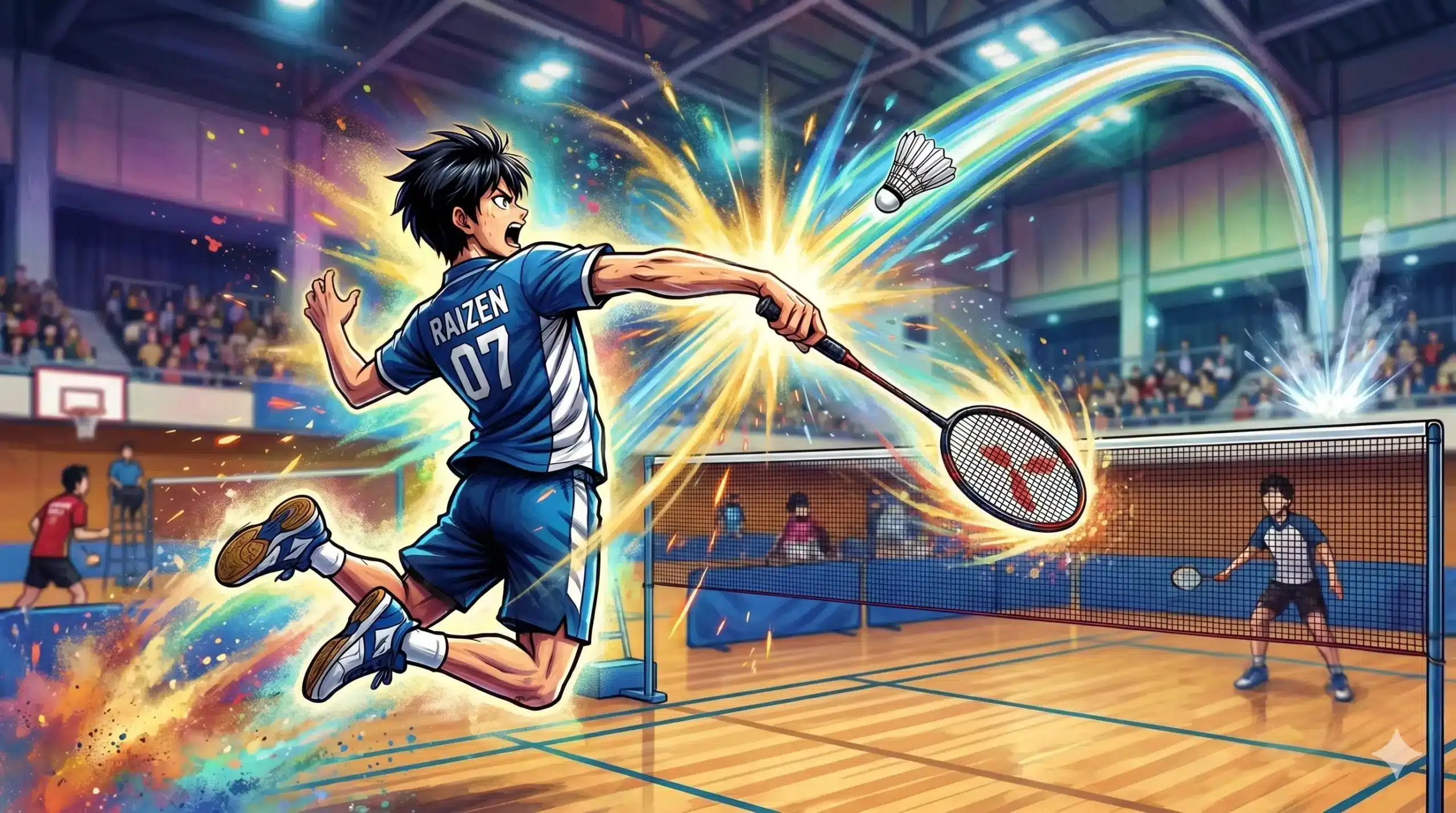

What is the clear in badminton?
The clear is a shot played from the rear court that sends the shuttle towards the opponent’s back boundary line, passing high over the net. Its trajectory determines its nature: a defensive clear is high and slow, while an attacking clear is fast and flat, travelling just above the opponent’s racket.
According to the BWF Coach Education Manual (Module 7), the forehand clear is considered a versatile shot that can be played in offensive, defensive or neutral situations (maintaining the rally). Its main purpose: forcing the opponent to retreat to the rear court, opening up the forecourt for the next shot.
Why the clear is a fundamental shot
The overhead clear is arguably the most important shot to master because it serves as the biomechanical template for several other rear-court strokes. Bernd-Volker Brahms, in his Badminton Handbook, emphasises that the smash and the drop are derived from the same preparation movement as the clear. For the opponent, this presents a major difficulty: until the very last moment, they cannot know which of the three shots is about to be played.
Three main reasons make it indispensable:
- Push the opponent back and create attacking opportunities in the forecourt
- Buy time to recover to central position and regain balance
- Serve as the technical foundation for the smash and drop thanks to an identical backswing
It’s also a shot found at every skill level, from the beginner learning to hit high to the Olympic champion turning a defensive clear into a tactical weapon. For a broader overview of essential strokes, see our complete guide to fundamental badminton techniques.
The three types of clear
Contrary to the common belief that there are only two clears, the BWF manual clearly distinguishes three variants based on tactical intent. The trajectory changes, but so does the contact point and the racket-face angle at impact.
| Type | Trajectory | When to use | Tactical goal |
|---|---|---|---|
| Defensive | High and slow, nearly vertical descent | Emergency, off-balance, recovery | Buy time to reposition |
| Attacking | Flat and fast, just above the opponent’s racket | Opponent out of position, shuttle taken early and high | Pressure the opponent, force a weak return |
| Neutral | Intermediate, firm but not flat | Sustaining the rally, building the point | Keep the initiative without taking risk |
Forehand clear technique: the 4 BWF phases
The BWF manual breaks down the stroke into four successive phases. This structure, validated by biomechanical analysis, serves as a global reference in coach education worldwide.
1Preparation
- Adopt the universal grip (basic forehand grip), soft and relaxed
- Hold the racket ready, head above the head
- Raise the non-racket arm in front for balance and aiming
- Stand sideways to the net, body weight on the front foot (opposite side of the racket arm)
- Keep your eyes on the shuttle
2Backswing
- Move the back leg forward (block step), keeping the foot parallel to the back boundary line
- Transfer body weight onto this bent back leg
- Push the back hip forward
- Raise and bring the elbow forward, place the racket behind the head (“as if pulling the racket out of a backpack”)
- Perform a supination of the arm and forearm (external rotation)
- The non-racket arm controls the body rotation
3Forward swing and impact
- Perform an explosive pronation of the arm and forearm (internal rotation)
- Extend the arm to hit the shuttle above or slightly in front of the racket-side shoulder
- Strike at the highest possible point, with a straight arm
- The body arches like a drawn bow during the jump
- The back leg passes forward (scissor jump) after impact
4Follow-through
- Racket speed carries the arm into completing the pronation while relaxing
- Land on the front foot (left foot for a right-hander), toes pointed sideways to protect the Achilles tendon
- Momentum naturally carries the player back to the centre of the court
- The back foot becomes the front foot in the recovery step
The kinetic chain: where does the power really come from?
For a long time, it was believed that the power of the clear came mainly from the wrist. High-speed biomechanical analyses conducted in the 1980s and 1990s put an end to this myth. According to research published in Sport & Vie, it is the additive sum of segment velocities that creates the final racket-head speed at impact.
The sequencing is precise and matters as much as the force mobilised:
- Ground push from the feet (legs, glutes) — the primary engine
- Hip rotation (90° to 180°), while shoulders remain sideways
- Dorsal torsion: the dorsal muscle chain stretches like a flexible metal blade being twisted
- Shoulder rotation triggered by the recoil of the torsion
- Elbow extension and forearm pronation (which alone accounts for about 53% of the final racket-head speed according to video analysis studies)
- Final finger action on the racket
This chain explains why elite players reach racket-head speeds of around 70 m/s at impact, while beginners hitting with “short arm” stay well below. Footwork and trunk-arm coordination matter as much as a muscular swing.
The backhand clear: the defensive shot par excellence
The backhand clear is regarded by the BWF manual as an essentially defensive or neutral shot. Unlike its forehand counterpart, it is more technically demanding and offers less power and accuracy. Brahms ranks it among the most technically challenging strokes in badminton.
Mechanics of the backhand clear
- Preparation: forehand or pinch grip, elbow lowered, racket head pointing up
- Approach: rotate the body at least 90°, back partially turned to the net
- Backswing: bent elbow rises, racket head drops, pronation of arm and forearm
- Forward swing: arm extends in a relaxed manner, explosive supination, contact point on the side or slightly behind the player, hand under the shuttle
- Strike: “tap” the shuttle by hitting it sharply and stopping the hand immediately after impact (rebound effect)
- Follow-through: the hand stops but the racket head continues, the racket rebounds backward in a relaxing motion
Common errors and how to fix them
Progressive drills to master the clear
Progression follows a motor learning logic: isolate the stroke, enrich it, then integrate it in real play. The drills below are drawn from the BWF Manual and Brahms’ Badminton Handbook.
Drill 1 — Suspended shuttle (no-shuttle learning)
Hang a shuttle at natural striking height. Adopt the universal grip, raise the arm, form the arm-racket angle, perform forearm rotation to hit. This drill isolates pronation/supination without motor interference.
Drill 2 — Shuttle throwing
Two players throw a shuttle hard to each other, respecting the mechanics of the striking motion (hip rotation, shoulder opening, final arm action). This drill perfectly transfers the kinetic chain sensation to the racket.
Drill 3 — Double trouble (Brahms)
Hit clears holding two stacked shuttles in the same hand. The extra weight forces the proper mobilisation of the entire kinetic chain to reach the opposite back boundary line.
Drill 4 — Clear with drop pause
Player A serves high, player B clears. A then plays a drop, B responds with an underhand clear. Then A clears again and the sequence restarts. Ideal for working clear endurance and varying strokes.
Drill 5 — Alternate clear
Player A plays only attacking clears (flat), player B only defensive clears (high). After 5 minutes, swap. This drill makes the difference between the two trajectories physically tangible and trains conscious choice.
Drill 6 — Cross or longline
Player A in the rear court plays a straight or cross-court clear. Player B must return with a high clear. This drill integrates directional precision into the basic stroke.
Drill 7 — Shadow with scissor jump
Perform the full motion without a shuttle, with a scissor jump at every repetition. If the footwork sequence is wrong, repeat 3 times without a shuttle. This drill automates leg-arm coordination.
To go deeper on footwork, see our complete guide to badminton footwork and movement patterns.
When to play which clear? Tactical choice
The choice between the three variants depends on three variables: your position on the court, your opponent’s position, and the quality of the shuttle you receive.
| Situation | Recommended type | Why |
|---|---|---|
| Shuttle taken early, opponent out of position in forecourt | Attacking | Opponent won’t have time to retreat properly |
| Shuttle taken late or off-balance | Defensive | High trajectory buys time to recover |
| Long, stable rally | Neutral | Keep the initiative without risking a counter-smash |
| Backhand corner of the rear court | Defensive (backhand) | Backhand rarely offers enough power for attacking |
| Opponent anticipates straight shots | Cross-court clear | Changing the diagonal breaks the anticipation pattern |
Frequently asked questions about the clear
How long does it take to master the clear?
For a regular beginner (2 sessions per week), it takes 3 to 6 months to achieve a clean execution of the forehand clear reaching the opponent’s back boundary line. The backhand clear takes longer, typically 6 to 12 months for proper technical mastery. Progress depends mostly on the consistency of footwork and trunk-arm coordination training.
My clear is too short, what’s the main cause?
In 80% of cases, the problem doesn’t come from “lack of strength” but from the contact point. If you strike behind your head rather than above or in front of the shoulder, you angle the racket face upward and lose distance. The second classic cause is the absence of forearm pronation at impact.
Do you have to jump to play a good clear?
No, jumping is not mandatory. The BWF manual teaches the clear first with a block step (planted foot) without jump. The jump clear is an advanced variant that raises the contact point and allows hitting the shot earlier, but it comes after mastering the base motion. Jumping too early degrades technique rather than improving it.
What’s the difference between a clear and a lob?
The clear is played with an overhead stroke, from the rear court towards the opposing rear court. The lob (or lift in BWF terminology) is played with an underhand stroke, from the forecourt, and sends the shuttle in a high arc to the opposing back boundary line. Both reach the same destination but their starting point and mechanics are completely different.
How to train the clear when practising alone?
Several options: shadow drills with and without scissor jumps, wall hits aiming high, shuttle-throwing drills to anchor the kinetic chain, and filming yourself (phone propped on a bag) to compare your motion to the BWF phases. Isolated pronation/supination work with a small weight in the hand is also very effective.
Is the attacking clear more effective than the smash?
Not exactly more effective, but complementary. The smash is a finishing shot aimed at ending the rally. The attacking clear is a pressure shot: it forces the opponent to retreat quickly while staying with an overhead stroke, which often sets up the next smash. Many elite players alternate attacking clear and smash to break anticipation. To dive deeper, see our article on the badminton smash: technique, power and placement.
Sources and references
- Badminton World Federation (2011). Badminton Coach Education Manual, Level 1, Module 7 (Stroke Skills), section 14 a (The Forehand Overhead Clear) and 14 e (The Backhand Overhead Clear).
- Badminton World Federation (2013). Badminton Coach Education Manual, Level 2, Module 5 (Performance Factor 1 – Strokes).
- Brahms, B.-V. Badminton Handbook: Training, Tactics, Competition, Chapter 8 (The Clear) and Chapter 12 (The Backhand), Meyer & Meyer Sport.
- Sport & Vie n°143 (March-April 2014), feature “How to gain speed — Lessons from badminton”, on stroke biomechanics and the addition of segment velocities.
- Weiß, M. Badminton, chapter on fundamental strokes (attacking and defensive clear).