

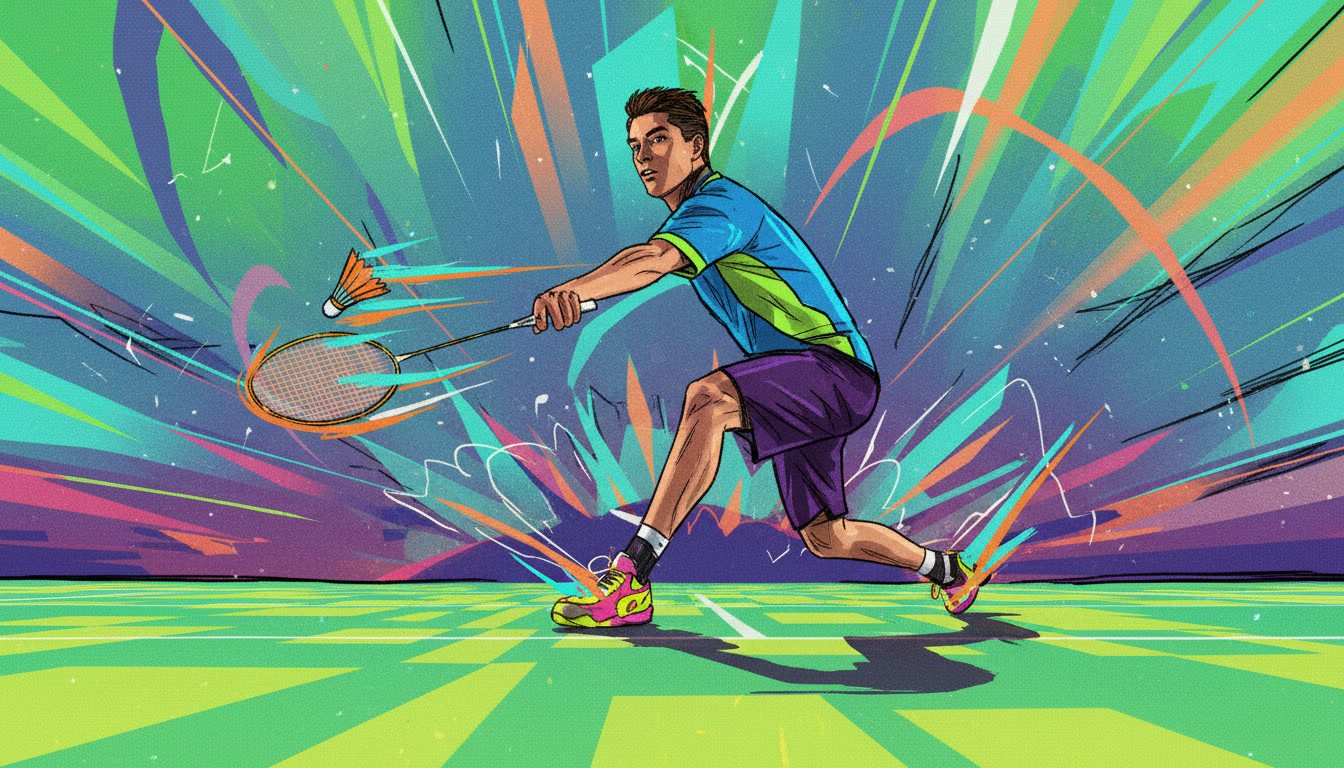

Badminton is a technically demanding sport that combines power, precision, and finesse. Played at the highest level, it requires exceptional physical qualities and flawless technical mastery. With shuttlecocks struck at over 300 km/h and athletes demonstrating outstanding physical abilities, modern badminton represents one of the fastest racket sports in the world. This comprehensive guide explores the fundamental techniques essential for progress, from serves to net shots, mid-court play, and backcourt strokes.
Biomechanical Fundamentals of Stroke Production
Before examining specific shots, it is essential to understand the biomechanical principles underlying effective striking in badminton. According to the Badminton World Federation (BWF), technique relies on four key elements: flexion, extension, rotation, and force generation.
Badminton biomechanics follows a fundamental principle of speed summation. As explained in the BWF coaching manual, “the principle of speed summation states that the final velocity of the movement depends on integrating all velocities from previous sequences” (BWF, Level 1 Coach Manual, 2013). This process begins with the push of the feet on the ground, continues through finger action on the racket, and culminates in the central rotation of the entire body.
The Four Biomechanical Principles of the Smash:
Scientific research has demonstrated that a powerful smash relies on four essential mechanisms. Shuttle velocity can exceed 300 km/h through optimal combination of these factors:
- The principle of speed summation: progressive integration of all body segments
- Back torsion: leverage effect through trunk rotation (90 to 180 degrees)
- Radio-ulnar pronation: rapid internal rotation of the forearm at impact
- Finger contribution: final action at shuttle contact to maximize velocity
Source: Sport et Vie n°143, “The Four Keys to the Smash”
Racket Grip: Foundation of All Techniques
The racket grip constitutes the foundation of all badminton techniques. An improper grip compromises the effectiveness of all shots and limits player progression. The BWF identifies several grip types according to game situations.
The Universal Grip (or Handshake Grip)
The universal grip, also called the handshake grip, is badminton’s fundamental grip. As the name suggests, you hold the racket as you would shake someone’s hand. This grip allows natural 120-degree wrist rotation, essential for shot variety.
To achieve this grip, “the hand runs along the handle with fingers slightly spread, the thumb positioned on the wide side of the grip” (BWF, Technical Manual 2013). This position enables maximum flexibility while maintaining optimal racket control.
Specialized Grips
Beyond the universal grip, badminton requires grip adaptation according to situations:
- Forehand grip: used for dominant-side shots, maximizing power
- Backhand grip: thumb positioned flat on the wide face of the handle for better stability
- Panhandle grip: short grip employed for delicate net touches
Service Techniques: Starting the Rally
The serve represents the only shot the player controls completely, without opponent pressure. In badminton, unlike tennis, all serves must be executed underhand, meaning with the racket head below the hand at shuttle contact.
Backhand Short Serve
The backhand short serve forms the foundation of doubles play. According to BWF, this serve aims to “pass just over the net with the flattest possible trajectory, forcing the opponent to lift the shuttle”. The tactical objective is to limit the opponent’s offensive options from the rally’s start.
Backhand Short Serve Technique:
- Position: feet shoulder-width apart, slightly sideways
- Grip: backhand grip with thumb flat on handle
- Movement: short, crisp motion, racket pushed forward
- Contact: strike shuttle in front of body, hip height
- Trajectory: skimming over net, quick drop in opponent’s service zone
BWF, Coach Manual, Module 7
Forehand High Serve
More commonly used in singles, the forehand high serve aims to send the shuttle deep to the opponent’s backcourt. This serve requires precise coordination between arm movement and body weight transfer. The high, deep trajectory aims to push the opponent back and limit attacking angles.
Drive Serve
The drive serve, also called flick serve, represents an important tactical variant in doubles. It is a fast, flat serve aimed at the opponent’s body or sides to surprise them and create a weak return.
To master all strategic and tactical aspects of serving, check our complete guide to badminton serve.
Forecourt Shots: Mastering Net Play
Forecourt shots are crucial for controlling rally rhythm and creating scoring opportunities. These shots demand finesse, control, and excellent game reading.
Net Drop
The net drop (or net shot) consists of delicately returning the shuttle just behind the opponent’s net. BWF emphasizes the importance of “hitting the shuttle at the highest possible point to limit opponent reaction time”. This technique can be executed forehand or backhand.
Backhand technique: The movement begins with a rapid advance toward the net with a forward lunge. The backhand grip allows better control for delicate touches. Shuttle contact occurs in front of the body, with minimal racket movement to absorb speed and gently place the shuttle.
Forehand technique: The principle remains similar, but the forehand grip offers more variety in shuttle direction. Players can easily direct their drop straight or cross-court according to opponent position.
The Lift
The lift represents an essential defensive shot from the forecourt. Its objective is to return the shuttle high and deep to the opponent’s backcourt, giving the player time to recover position. As the BWF manual indicates, “lifts must have good length and be high enough to pass over the opponent’s racket”.
Lift technique requires significant leg flexion in lunge position, followed by explosive push during the stroke. Racket movement goes from low to high, accompanying the shuttle on an ascending trajectory.
Net Kill
When the shuttle is sufficiently high above the net, players can execute a net kill, striking the shuttle downward with a descending trajectory. This rapid, incisive shot aims to finish the rally or force an opponent error.
Mid-Court Shots: Transition Zone
The mid-court represents a transition zone where players must react quickly to opponent shots, particularly in doubles.
The Block
The block is a defensive shot used to return an opponent’s smash. The objective is not to return with power, but to redirect the shuttle with control, generally toward the opponent’s forecourt. Racket position is crucial: it must be held in front of the body, slightly angled to absorb the smash’s power.
According to BWF, “a straight block to defend a cross-court smash makes follow-up more difficult for the smasher”, creating an advantageous tactical situation.
The Drive
The drive is a fast, flat shot, struck at shoulder height, that crosses the court horizontally. Used mainly in doubles, this shot maintains pressure on the opponent and leaves little reaction time. Drives can be executed forehand or backhand, with rapid wrist action at impact.
Backcourt Shots: Power and Precision
Backcourt shots constitute badminton’s primary offensive arsenal. They require optimal whole-body coordination and flawless technique to be effective.
The Clear
The clear sends the shuttle high and deep to the opponent’s backcourt. This fundamental shot serves to push the opponent back, gain time to recover position, or create tactical openings. Two types of clears exist:
- Defensive clear: very high, vertical trajectory, giving maximum recovery time
- Attacking clear: flatter, faster trajectory, aiming to press the opponent without time to organize
Forehand clear technique begins with lateral positioning to the shuttle. The BWF manual specifies that players must “position sideways, raise the non-racket arm for balance, then push the back hip forward” to generate power.
The Smash: Supreme Offensive Weapon
The smash represents badminton’s offensive shot par excellence. Struck with a descending trajectory, it aims to finish the rally or force a weak opponent return. Top players can hit smashes exceeding 400 km/h.
Complete Forehand Smash Technique:
Preparation:
- Forehand grip
- Lateral positioning under shuttle
- Racket prepared above head
- Free arm raised for balance
Wind-up phase:
- Back foot movement forward
- Back hip rotation
- Arm and forearm supination
- Elbow and shoulder drawn back
Strike phase:
- Explosive forearm pronation
- Complete arm extension
- Contact above or slightly in front of hitting shoulder
- Downward trajectory imparted to shuttle
Follow-through phase:
- Continued forearm rotation
- Racket maintained in front
- Landing on back foot then front foot
BWF, Coach Manual, Section “The forehand smash”
Smash biomechanics are particularly complex. According to analyses published in Sport et Vie, “during a smash, 53% of racket head velocity was due to internal forearm rotation associated with shoulder rotation”. This radio-ulnar pronation therefore represents the crucial mechanical element for generating power.
Backcourt Drop Shot
The backcourt drop shot represents a tactical alternative to the smash. Struck from the backcourt with identical preparation to the smash, this shot sends the shuttle toward the opponent’s forecourt with a soft descending trajectory. The drop aims to deceive the opponent expecting a smash and make them run forward.
BWF distinguishes two types of backcourt drops: the fast drop (slice drop) with a flatter trajectory, and the slow drop with a higher trajectory allowing better placement precision.
Hand-Eye Coordination and Timing
Beyond pure shot technique, badminton demands exceptional hand-eye coordination. Even before learning shots with a racket, BWF recommends that “children must acquire skills for catching, throwing, and hitting, enabling them to develop effective trajectory-reading competencies”.
This ability to read shuttle trajectory and anticipate impact point largely determines stroke quality. Elite players excel at this early game reading, allowing optimal positioning and striking the shuttle at the best moment.
Importance of Racket Head Speed
Velocity imparted to the shuttle depends directly on racket head speed at impact. As biomechanical principles explain, this speed results from a kinetic chain starting from the feet and ending with final finger action.
Studies have shown that racket head speed during a smash can exceed 70 meters per second. This phenomenal speed is achieved through progressive accumulation of all body rotation velocities, from legs to fingers, following the principle of speed summation.
Footwork Associated with Techniques
No technique can be effective without appropriate footwork. Badminton requires perfect coordination between movements toward the shuttle and technical stroke execution. BWF structures footwork learning into several components:
- Split step: starting position enabling explosive start in all directions
- Approach: movement toward shuttle with steps adapted to each court zone
- Strike: optimal position to execute the shot (lunge, jump, chasse steps)
- Recovery: rapid return to base position after striking
These movements vary by court zone. For forecourt, a forward lunge reaches the shuttle near the net. For forehand backcourt, chasse steps or running backward are necessary. For backhand backcourt, a pivot or jump may be employed. For complete mastery of movement patterns, check our complete guide to badminton footwork.
Progression and Technical Learning
BWF recommends a structured pedagogical progression for teaching techniques. For beginners and children, the suggested order starts with the simplest shots:
- Backhand serve
- Forecourt strokes
- Backcourt overhead shots
- Variations and technical refinements
This progression builds a solid technical foundation before approaching more complex shots. Each shot should be worked in isolation first, then progressively integrated into real game situations.
Technical Adaptation According to Disciplines
While basic techniques remain identical, their use varies by discipline (singles, doubles, mixed). In singles, emphasis is placed on clears and backcourt shots to push the opponent back. In doubles, fast, flat mid-court shots (drives, blocks) become more important.
Doubles also requires different serves. According to BWF, “in women’s doubles, the server serves near the T on court, while her partner stands at mid-court center”, a tactical formation specific to this discipline.
Conclusion: Progressive Technical Mastery
Fundamental badminton techniques constitute the cornerstone of all progression in this demanding sport. From serve to drop, from smash to clear, each shot possesses its own biomechanical characteristics and specific tactical utility.
Mastering these techniques demands patience, repeated practice, and understanding of underlying principles. As the Badminton World Federation emphasizes, technical progression necessarily accompanies development of motor skills, physical condition, and tactical intelligence. To effectively structure your overall progression, check our complete guide to improving quickly at badminton.
At the highest level, badminton becomes a sport where technical excellence combines with exceptional physical qualities: aerobic endurance, explosive power, speed, and agility. However, even for amateur players, understanding and correct application of fundamental techniques enables rapid progress and enjoyment in practice.
Modern badminton teaching, based on BWF standards, offers a structured and progressive approach that guarantees acquisition of solid technical foundations, an indispensable basis for any player wishing to evolve in this fascinating sport.
Sources and References
- Badminton World Federation (BWF) – Level 1 Coach Manual, First edition 2013. Kuala Lumpur, Malaysia. Official coach training document including complete technical modules on performance factors.
- Sport et Vie n°143 – Feature “The Four Keys to the Smash” – Detailed biomechanical analysis of the badminton smash based on kinematic studies and field measurements.
- BWF – Official badminton rules and para-badminton classification system. Available at www.bwfbadminton.org
- World Guinness Book – Official shuttlecock speed record (493 km/h at racket exit).
Note: This article relies on Badminton World Federation technical standards, badminton’s world governing body, ensuring accuracy and conformity of presented technical information.