

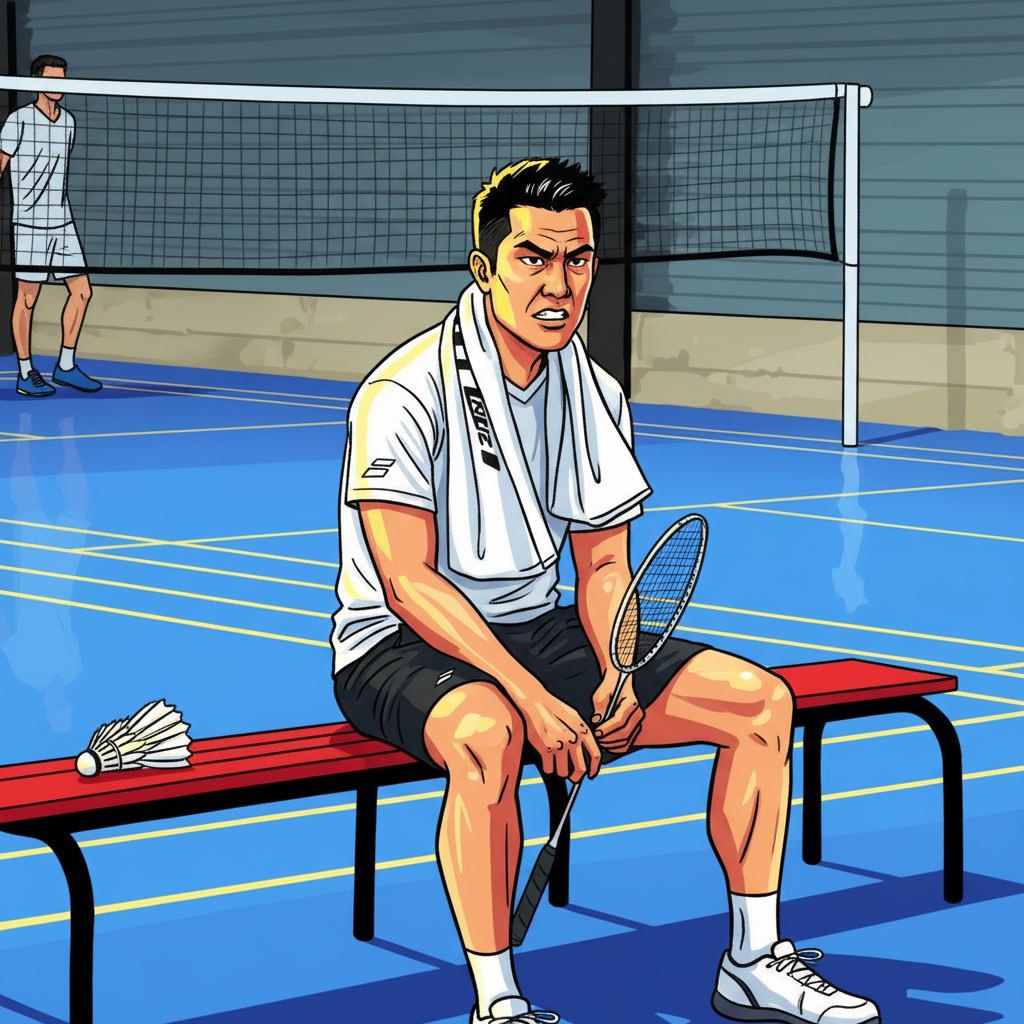

What is Sports Psychology in Badminton?
The Badminton World Federation defines sports psychology as:
“The mental processes and behaviors of individuals and groups in sport.”— BWF Coach Manual, Module 10
This psychological dimension influences all other aspects of the game. A player may possess impeccable technique and exceptional physical condition, but without adequate mental strength, they won’t be able to fully exploit their potential during crucial match moments.
Mental Training: Definition and Origin
The term “mental training” originates from sports psychology and refers to a specific practice:
“The repeated visualization or mental practice of an action, without physically performing the action.”— Sports Psychology Sciences
This knowledge and methods have their origins in behavioral therapy and have been adapted to meet sports psychology requirements. The modern holistic approach emphasizes that mental training must engage not only the mind but also the body, with both working in harmony so their powers can be focused and deployed toward the same goal.
The Three Domains of Sports Psychology
According to the BWF, sports psychology is divided into three distinct domains:
| Domain | Practitioners | Coach’s Role |
|---|---|---|
| Clinical psychology | Qualified psychologists with professional authorization | ❌ Outside competence – refer to specialist |
| Sports psychology research | University researchers and scientists | ⚠️ Collaboration possible but not leading |
| Training psychology | Trained coaches applying basic principles | ✅ Main area of action |
⚠️ Important Point
Coaches must stay within their area of competence and not get involved in clinical psychology without appropriate training. In cases of emotional or personality disorders in a player, it’s essential to refer to a qualified professional.
The 5 Pillars of Mental Performance (The 5 Cs)
The BWF has structured the psychological approach around five key domains, interdependent and essential for optimal performance. These five pillars, often called “the 5 Cs,” constitute the reference framework for developing a badminton player’s mental strength.
1. Control
Emotional control is the ability to manage reactions to stress and pressure situations in matches. A player who loses control wastes mental and physical energy, compromising their performance.
Deep Breathing Technique
The BWF recommends a particularly effective breathing technique between points:
Anti-Stress Breathing Protocol
- Stand with arms along the body
- Focus attention on the center of the body
- Breathe deeply from the belly (diaphragmatic breathing)
- Exhale while consciously releasing all tension: head, face, neck, shoulders, chest
- Repeat the process
- Think of a key word evoking the desired state (“calm,” “relaxed,” “focus”)
Key application points:
- Progressive learning: Practice first in training before using in matches
- Context adaptation: Between rallies, one deep breath may be enough due to time constraints
- Beneficial side effect: This technique helps clear the mind of parasitic thoughts, as it’s difficult to think about anything else during its implementation
Source: BWF Coach Manual, Module 10 – Control Section
Autogenic Training: The Schultz Method
To go further in emotional control and relaxation, some high-level players use Autogenic Training, a relaxation method through autosuggestion developed by German psychiatrist Johannes Heinrich Schultz in 1932.
This technique is based on autosuggestion-based relaxation, allowing complete body and mind relaxation. The central idea is that a calm body facilitates mental concentration and performance under pressure.
The 7 Exercises of Autogenic Training
The exercises consist of short visualization formulas that the player must repeat mentally, usually several times. This regular practice allows the body to integrate these relaxation states.
- Calmness exercise: “I am completely calm and nothing can bother me”
- Heaviness exercise: “My arms and legs are heavy” (muscle relaxation sensation)
- Warmth exercise: “My arms and legs are warm” (improved blood circulation)
- Breathing exercise: “My breathing flows calmly and evenly” (natural, fluid breathing)
- Heart exercise ⚠️: “My heart is beating calmly and regularly” — NEVER say “slowly” as this could cause cardiac irregularity in extreme cases
- Solar plexus exercise: “My abdomen is flowing with warmth” (center body relaxation)
- Head exercise: “My head is clear, my brain is cool” (maintaining alertness and improving concentration)
Recovery phase (essential):
To exit the light trance state, say emphatically: “Arms firm! Deep breath! Eyes up!” Then stretch arms. This recovery phase is vital to regain a normal alert state.
Application to badminton:
- Before competition: 10-15 minutes of Autogenic Training to achieve optimal calm
- Between matches: Shortened exercises (exercises 1, 4, and 7) for mental recovery
- Learning required: This technique requires regular training to be effective, ideally under professional supervision at first
💡 Autogenic Training vs BWF Breathing
Deep breathing (BWF): Quick, applicable between points, easy to learn — ideal for all levels
Autogenic Training: More complex, requires learning, used before/after matches — reserved for motivated and supervised players
2. Confidence
Self-confidence is the belief in one’s abilities to succeed. It’s based on several elements: technical mastery, accumulated experience, and validation through past results. A confident player dares to take calculated risks and maintains their level of play under pressure.
Building Confidence
Confidence develops progressively and is maintained through:
- Technical mastery: The more a movement is automated, the more confident the player feels executing it in matches
- Mental preparation: Visualizing successes and positively anticipating match situations
- Constructive analysis: Learning from defeats without self-devaluation
- Setting realistic goals: Celebrating small victories to maintain positive momentum
💡 Coach’s Tip
Encourage your players to keep a journal of their technical and tactical successes. Rereading these successes before an important match reinforces confidence in their abilities.
3. Concentration
Concentration is the ability to maintain attention on relevant game elements, eliminating internal distractions (parasitic thoughts, doubts) and external ones (crowd noise, match stakes).
Mental Imagery to Improve Concentration
The BWF recommends using mental imagery to help players focus on specific beneficial game aspects.
Practical Example: Reducing Line Faults
Problem: A player commits many faults by sending the shuttle outside the sidelines in singles.
Solution through mental imagery:
- The coach asks the player to mentally visualize a court with an imaginary corridor inside the singles lines
- The player strives to “see” this modified court in their mind
- During matches, they use this mental image of the narrowed court to adjust their accuracy
- The coach observes the evolution of fault numbers over several matches to evaluate the training technique’s effectiveness
Source: BWF Coach Manual, Module 10 – Concentration Section
Other mental imagery applications:
- Visualizing perfect execution of a technical shot before playing it
- Imagining a “concentration bubble” that isolates the player from distractions
- Mentalizing tactical scenarios to better anticipate in matches
Case Study: Peter Gade and Mental Training
The importance of mental training for concentration is illustrated by the case of Danish champion Peter Gade, considered among the favorites in major European tournaments but who long suffered from mental problems in competition.
Peter Gade’s Problem
Peter Gade was repeatedly considered the favorite in major competitions, but his nerves systematically betrayed him. According to sports psychologists who worked with him:
- Main symptom: He “bottled out” (cracked under pressure) and couldn’t play at his best during crucial moments
- Negative mental pattern: He wanted to mentally “cancel out” his opponents’ shots and would call faults before they even landed on court, which distracted him from his own game
- Consequence: This negative anticipation allowed the opponent to score a few extra points
Solution applied:
Peter Gade worked with psychologists to change this negative experience pattern using mental training techniques. The goal was to cause improvement in the actual action by working on conscious, intensive visualization.
Key principle: Improvement of action in consciousness (through intensive visualization) should lead to improvement of action when actually performed. The realized effect depends on how vividly the visualization is done — how realistic it is and how sensitive to internal processes involved.
Source: Sports Psychology – Elite Level Badminton
Pre-Match Mental Preparation Routines
Mental preparation before a match is different for each player. Sports psychologists observe very varied approaches among elite players:
| Preparation Type | Characteristics | Objective |
|---|---|---|
| Mental activation | Run through movements in head, then repeat in shadow badminton | Visualize actions then activate them physically |
| Maximum relaxation | Think as little as possible, relax as much as possible, stay calm | Save mental energy for the match |
| Progressive focus | First physical basics (calm waiting, quick landing, relaxed grip), then tactics | Build concentration from simple to complex |
🎯 Expert Recommendation
According to analysis of many high-level players, it’s crucial before focusing on tactics to pay attention to physical and mental basics:
- Wait calmly for shots
- Land quickly in corners
- Hold the racket with a relaxed grip until just before playing a shot
Only when these basics are in place can the player reach the shuttle quickly and early, and put tactics into practice effectively.
Fundamental principle: It’s essential that training engage not only the mind but also the body. Mental training and actual training must constantly alternate, allowing the player to compare visualized action with performed action.
4. Commitment
Commitment represents the level of motivation and involvement of the player in their practice. There are two fundamental types of motivation:
Intrinsic vs Extrinsic Motivation
| Type | Characteristics | Impact on Performance |
|---|---|---|
| Intrinsic motivation | Pleasure of playing, personal progress, game mastery | ✅ Durable, stable, pressure-resistant |
| Extrinsic motivation | Rewards, recognition, external results | ⚠️ Fluctuating, result-dependent |
Promoting Intrinsic Motivation
The BWF recommends coaches promote intrinsic motivation by encouraging players to set process-centered goals rather than only result-focused ones:
- Process goals (controllable): “Improve my recovery after each shot,” “Vary my serves,” “Maintain my concentration throughout the match”
- Result goals (less controllable): “Win the tournament,” “Beat that opponent,” “Finish in the top 3”
🎯 Coaching Strategy
Emphasize improvement processes to reduce result-related pressure. A player focused on their technical and tactical progress develops stronger, more lasting motivation.
Source: BWF Coach Manual, Module 10 – Commitment Section
5. Cohesion
Cohesion concerns the ability to create an effective training environment where a group of people work together harmoniously. It’s essential in doubles and for club team dynamics.
Techniques to Develop Cohesion
The BWF proposes several concrete approaches:
- Creating collective codes of conduct: Involving the whole group in establishing training rules fosters adherence and mutual respect
- Parent involvement: Integrating parents into the process of defining club values and objectives creates educational consistency
- Partner rotation: Regularly changing pairs and groups during practical exercises develops adaptability and strengthens team bonds
- Collective projects: Organizing camps, tournament trips, or team challenges bonds the group
Source: BWF Coach Manual, Module 10 – Cohesion Section
How to Integrate Mental Preparation into Training?
The BWF emphasizes the importance of integrating sports psychology into usual training practice rather than treating it as an isolated discipline. Here are the recommended guiding principles:
Complementary Mental Training Techniques
Beyond the 5 fundamental pillars, several complementary techniques are used by high-level players to strengthen their mental preparation:
- Meditation: Regular practice to develop the ability to stay in the present moment and not be distracted by parasitic thoughts
- Yoga: Allows achieving relaxation while working on the mind-body connection, particularly useful for recovery and stress management
- Introduction to positive thinking: Reinforce positive experiences by consciously remembering past successes — a player who recalls their victories develops stronger confidence
- Visualization guide: Structured protocols to visualize success in specific match situations
💡 Focus on Positive Thinking
Positive thinking is particularly effective when reinforced by remembered successes. For example, a player who mentally visualizes their celebration after an important victory neurologically reinforces circuits associated with success. This technique is well illustrated by the image of Danish mixed doubles players Peter Rasmussen celebrating their World Championship victory — remembering these moments of glory before a difficult match can significantly improve confidence.
Application Principles for Coaches
BWF Recommendations
- Start simple: Use straightforward psychological approaches aligned with your coaching philosophy (e.g., goal setting, pre-match routines)
- Natural integration: Associate sports psychology with usual practice as much as possible rather than creating separate sessions
- Respect your limits: Avoid addressing clinical psychology techniques that require specialized training
- Observe and question: Always start by asking the player “how are you doing?” to identify potential mental difficulties before choosing the appropriate approach
Progression According to Development Stages
The BWF structures psychology integration according to player development phases:
| Phase | Approximate Age | Psychological Focus |
|---|---|---|
| Learning to play | 6-12 years | Introduction to rules, game ethics, positive attitude toward self and others |
| Training to train | 9-16 years | Implicit mental preparation, mental endurance development, control and concentration |
| Training to compete | 12-18 years | Explicit support for the 5 Cs, progressive exposure to psychological training with specialists |
| Training to win | 16+ years | Individualized psychological program, possible intervention by sports psychology experts |
Source: BWF Coach Manual, Module 5 – Progression Table
The Interaction Between Mental and Other Performance Factors
Sports psychology doesn’t function in isolation. It constantly interacts with the four other performance factors identified by the BWF:
- Psychology × Technique: Confidence influences the ability to execute shots under pressure; technical mastery reinforces confidence
- Psychology × Tactics: Adapting to opponent’s shots requires concentration and calmness under pressure
- Psychology × Physical: Mental endurance allows maintaining physical effort; physical fatigue affects concentration
- Psychology × Lifestyle: Stress management influences sleep and nutrition; a balanced lifestyle promotes emotional stability
“Adapting to opponent’s shots (tactics) requires concentration and calmness under pressure situations (psychology).”— BWF Coach Manual, Module 5
Frequently Asked Questions About Mental Training in Badminton
Conclusion: Essential Foundational Work
Mental preparation in badminton is not a luxury reserved for high-level players, but an essential component of performance at all levels. The five pillars identified by the BWF — Control, Confidence, Concentration, Commitment, and Cohesion — form a structured and accessible framework for developing mental strength.
The approach recommended by the Badminton World Federation is distinguished by its pragmatism: integrate sports psychology naturally into daily training practice, without making it a hermetic or intimidating discipline. Simple techniques like deep breathing or mental imagery can have an immediate impact on stress management and concentration.
🎯 Key Takeaways
- Sports psychology influences all other performance factors (technique, tactics, physical, lifestyle)
- The 5 Cs are interdependent and must be worked on in a balanced way
- Psychological techniques must first be practiced in training before being used in competition
- Coaches must stay within their area of competence and refer to specialists when necessary
- Promote intrinsic motivation by setting process-centered goals rather than results
As the BWF reminds us, “all coaches use sports psychology to different degrees in their coaching practice.” The essential thing is to start, experiment, and progressively adjust your approach according to each player’s specific needs.
Sources and References
This article is based on the following official training documents and specialized works:
Main Sources
- Badminton World Federation (BWF) – Coach Manual Level 1, Module 10: Sports Psychology (First edition: 2013)
- BWF Coach Manual – Module 5: Performance Factors and Player Progression
- Elite Level Badminton – Sports Psychology – Chapter 16.5: Mental Training, including case studies (Peter Gade) and advanced techniques
Techniques and Methods Cited
- Autogenic Training – Method developed by Johannes Heinrich Schultz, German psychiatrist (Berlin), published in the book “Autogenic Training” in 1932
- Behavioral therapy – Origin of mental training methods applied to sports psychology
- Case studies: Peter Gade (Danish champion), analysis of negative mental patterns and applied solutions
To Learn More
To deepen your knowledge of mental preparation in badminton, also consult:
- Official BWF training courses for coaches (Level 1 and 2)
- Online resources at bwfbadminton.com
- Specialized works on sports psychology applied to badminton
- Consultation with certified sports psychologists for complex cases
⚠️ Important Reminder
Advanced techniques like Autogenic Training should ideally be learned under qualified professional supervision, particularly during initial sessions. Coaches must stay within their area of competence and refer to certified sports psychologists when necessary.