

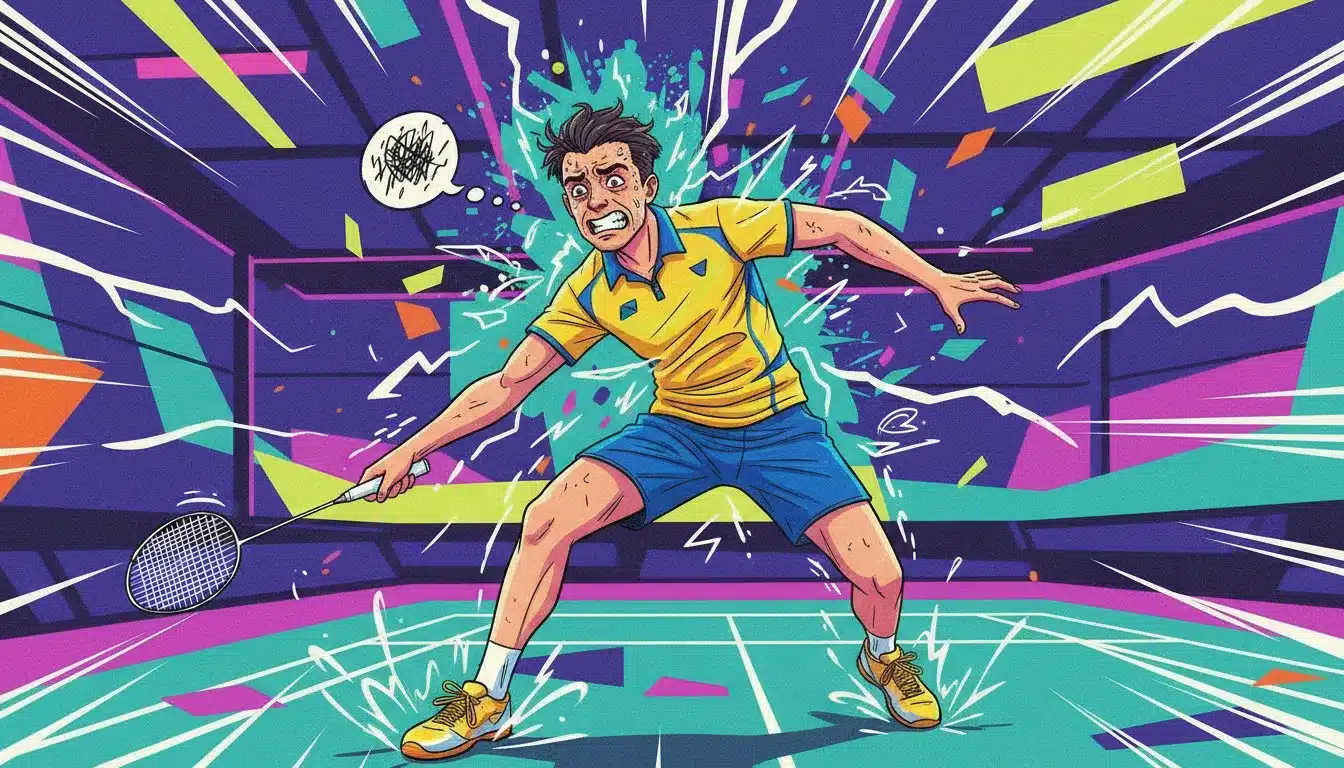

You play well in training but fall apart in matches? You lose your composure on the big points? You are not alone — competitive pressure is one of the most common challenges in badminton. This guide, based on the official Badminton World Federation (BWF) coaching manuals, gives you concrete tools to turn stress into performance fuel.
What Is Competitive Pressure and Why Does It Affect You?
Competitive pressure in badminton is a reality every player faces, from beginners to world champions. It shows up as an accelerating heart rate, sweaty hands, racing thoughts, and technique that breaks down on crucial points. But where does it actually come from?
According to sports psychology, pressure results from a perceived imbalance between the demands of a situation (the stakes of the match) and the resources a player believes they have available to meet them. The greater that gap, the more intense the pressure.
Research dating back to 1908 established an inverted-U relationship between arousal level and performance. A player who is under-activated (lethargic, disengaged) performs poorly. A player who is over-activated (anxious, tense) also performs poorly. The optimal performance zone sits between the two. BWF Level 2 – Module 10
| Activation State | What You Feel | Impact on Play | What to Do |
|---|---|---|---|
| Under-activated | Flat, unfocused, low energy | Slow reactions, lack of intensity | Activate: energising music, dynamic warm-up |
| Optimal zone | Alert, focused, controlled energy | Sharp reflexes, clear decisions, fluid technique | Maintain: stable pre-match routines |
| Over-activated | Nervous, tense, racing thoughts | Unforced errors, degraded technique, rushed decisions | Calm down: breathing, progressive relaxation |
The 4 Pillars of Mental Control in Competition BWF Level 2 – Module 10
The BWF Level 2 Manual identifies five key psychological components of badminton performance: cohesion, commitment, concentration, confidence, and control. In competition, control is the central element that enables all the others to function. Here are the four levers of mental control.
Concentration
Directing attention towards relevant elements of play — your position, the shuttle, open spaces — while ignoring distractors such as crowd noise, line calls, or opponent behaviour.
Confidence
Believing in your ability to execute the required actions. True confidence does not depend on winning — it depends on giving 100% effort. That way, it always remains under your control.
Arousal Control
Regulating your activation level to stay in the optimal zone. Increasing intensity when you are too flat; calming yourself when over-aroused.
Performance Routines
Personalised rituals — before the match, between rallies, between sets — that create psychological anchors and maintain a stable activation level throughout the match.
Technique 1: Diaphragmatic Breathing to Manage Immediate Stress
Breathing is your most powerful and immediately accessible tool during a match. It acts directly on the autonomic nervous system, lowering heart rate and releasing muscular tension within seconds.
The BWF Level 1 Manual describes a precise abdominal breathing technique to use between rallies:
- Stand upright with your arms naturally at your sides.
- Focus your attention on the centre of your body — your belly, not your chest.
- Inhale slowly and deeply from the belly: your abdomen expands, your chest remains relatively still.
- Exhale and release all tension from the upper body: head, face, neck, shoulders, chest. Let everything drop.
- Repeat once or twice between rallies, or three to five times during changeovers.
- Associate a word mentally with this state: “calm”, “relax”, “here”.
Technique 2: Self-Talk to Reshape Your Inner Dialogue
What you say to yourself during a match has a direct and measurable impact on your performance. The BWF Level 2 Manual dedicates an entire section to self-talk as a tool for regulating arousal and maintaining confidence.
The Two Types of Self-Talk
❌ Negative Self-Talk
“I’m going to miss this smash again”, “I’m terrible on this side”, “I can’t win this match”, “That call just cost me everything”…
→ Increases stress, erodes confidence, degrades technique.
✅ Positive and Instructional Self-Talk
“Relax”, “Breathe”, “Play long”, “One point at a time”, “Give my best”, “Here and now”…
→ Maintains focus, regulates activation, preserves confidence.
The BWF recommends short, simple, positive phrases: “relax”, “breathe deep”, “calm down”, “keep trying”. These cues are effective precisely because they are brief — they do not overload cognition during a rally.
The most effective method for maintaining confidence under pressure is to redefine the goal: not “winning”, but “trying 100% to give my best”. The advantage of this goal? It is entirely under your control, regardless of the opponent’s level or external circumstances. A player aiming for 100% effort always keeps their confidence intact, whether they win or lose.
Technique 3: Mental Visualisation
Visualisation — also called mental imagery — is a technique used by top players worldwide to mentally prepare for competition. It involves imagining, with as much detail as possible, match situations and the ideal technical and emotional responses to them.
How to Practise Visualisation
Visualisation is only effective when it engages both mind and body simultaneously. Here is how to structure a session:
- Choose a quiet moment — before sleep or at the start of a training session. Five to ten minutes is enough.
- Close your eyes and breathe deeply — settle into a calm, focused state.
- Visualise the scene with precision — the court, colours, sounds, physical sensations. Imagine yourself delivering a perfect serve, executing a decisive cross-court smash, or staying composed at 19-19.
- Attach the emotional feelings — feel the confidence, fluidity and control you want to experience.
- Alternate visualisation and real practice — mental imagery must be regularly compared and adjusted against on-court reality.
In a guided training context, your coach can ask you to mentally narrow the court — for example, imagining a boundary line a few centimetres inside the sidelines to improve precision without risking errors. This guided imagery technique translates into measurable accuracy gains during real play. BWF Level 1
Technique 4: Mastering Nideffer’s Concentration Styles
One of the most practical contributions of the BWF Level 2 Manual is Nideffer’s attentional model (1976). This framework helps you understand where and how to direct your focus depending on the moment in the match.
🧠 Broad – Internal
When to use: between rallies, during changeovers.
Role: analyse the situation, draw on experience, build a tactical plan.
👁️ Broad – External
When to use: during the rally, as the opponent prepares to strike.
Role: read opponent cues — differences in preparation between a drop shot and a clear.
💭 Narrow – Internal
When to use: before serving or receiving.
Role: execute a routine, control breathing, regulate activation level.
🎯 Narrow – External
When to use: at the moment of striking the shuttle.
Role: total focus on the precise action — the racket-shuttle contact.
Competitive pressure often locks a player in Narrow-Internal mode (ruminating on past errors, anticipating consequences) when they should be in Broad-External mode. Recognising this shift is the first step to correcting it.
Technique 5: Performance Routines
Routines are behaviours performed consistently and systematically that create a psychological anchor between a desired mental state and a match situation. They are among the most powerful tools for maintaining control in competition because they are familiar and associated with success.
The 3 Types of Competition Routines
Pre-Match Routine
A warm-up of set duration and content, discussion with the coach, chosen music, solo or group preparation. Personalise it around whatever puts you in the best mental state.
Between-Rally Routine
Return to centre, bounce the shuttle, one diaphragmatic breath, a mental cue word (“focus”, “now”, “ready”), reset position. The whole sequence should take no more than 15 to 20 seconds.
Between-Set Routine
Broad-Internal analysis phase (what happened?), tactical adjustment, physical recovery (hydration, breathing), confidence rebuild heading into the next set.
The BWF Manual is clear that these routines are not universal: “These routines are not the same for each individual.” The key is to identify yours through trial and error in training, then apply them consistently in competition.
Managing Specific High-Pressure Situations
Decisive Points (19-19, 20-20, Match Point)
These moments concentrate the full psychological pressure of a match. Danish researcher Kristoffer Henriksen, professor of psychology at the University of Southern Denmark, has shown that the most effective way to handle these situations in competition is to have already experienced them in training. The strategy: deliberately create match scenarios in practice that simulate exactly this kind of pressure, then debrief with coach and training partners to analyse how each player responded.
Bad Calls and Opponent Gamesmanship
The BWF Manual is explicit: there are two categories of distracting factors — those you can act on, and those you cannot control. Umpire errors, opponent gamesmanship, and crowd noise belong to the second category. The only effective response is to accept what you cannot control and immediately redirect attention to what you can — your next serve, your court position, your breathing.
Pre-Match Nerves
Pre-competition nerves are normal and, to a point, beneficial — they signal that you care about what you are doing. They become a problem only when they push you above your optimal activation zone. Progressive relaxation is the most appropriate tool in this case.
Progressive relaxation (BWF Level 2) combines diaphragmatic breathing with systematic tension-and-release of muscle groups. The technique requires months of regular practice to master, but once embedded it can produce a state of deep release in just a few seconds — ideal during changeovers or before a crucial serve.
Note too that factors such as music choice, solo versus group preparation, and whether you stay immersed in the competition atmosphere or step away from it all significantly influence your activation level. Identify what works for you and codify it into your pre-match routine.
Common Mental Errors in Competition and How to Fix Them
If you want to analyse your in-match errors systematically — not just mental ones but technical too — our guide Common Badminton Mistakes and How to Fix Them offers a comprehensive approach.
| Common Mental Error | What Is Actually Happening | The Fix |
|---|---|---|
| Constantly watching the score | Narrow-Internal focus parasites the Narrow-External needed during the rally | “One rally at a time” mindset — the score only exists between points |
| Replaying the previous error | Rumination occupies working memory and degrades the next decision | Breathing + cue word + immediate return to centre |
| Watching the opponent’s behaviour | Attention dispersed towards uncontrollable elements | Active recentering: “What can I control right now?” |
| Excessive outcome expectations | Confidence conditional on the result (uncontrollable) → fragility | 100% effort approach: the goal is intensity, not the score |
| Playing not to lose | Defensive strategy, safe shots, loss of tactical initiative | Process goals: court positioning, short serve, counterattack patterns |
🗓️ 4-Week Mental Training Plan
- Week 1: Master diaphragmatic breathing. Practise 5 min/day off court, then integrate it between every rally during training.
- Week 2: Develop your self-talk. Choose 3 personal cue phrases (“relax”, “focus”, “one point”) and use them systematically between rallies.
- Week 3: Build your between-rally routine (15–20 sec max). Test it in training under simulated pressure situations.
- Week 4: Introduction to visualisation. 8 minutes before each session: visualise 3 difficult match situations and your ideal mental responses.
Training Under Pressure: Preparing for Adversity in Advance
The most effective mental preparation comes from deliberately creating pressure situations in training. The logic is straightforward: if you can predict the disruptions you will face in competition and habituate yourself to them, they lose their power to destabilise you.
Concrete examples of pressure training exercises:
- Deficit sets: Always start at –5 (opponent leads 5-0). Learn to manage the pressure of coming from behind.
- Deliberate distraction: Ask observers to create noise, commentary or a simulated difficult crowd during rallies.
- Pressure rules: Any unforced error in the last 5 points of a set gives the opponent a 2-point bonus.
- Partner rotation: Play against stronger opponents regularly to habituate your nervous system to performing under discomfort.
- Systematic debrief: After every pressure exercise, take 5 minutes to analyse — what did you feel? What did you do? What will you do differently next time?
Frequently Asked Questions About Managing Pressure in Badminton
Conclusion: Pressure Is a Skill You Can Train
Managing competitive pressure in badminton is not an innate talent reserved for champions. It is a skill that is learned, exactly like the smash or the short serve. It is trained, developed, and consolidated through consistency and method.
Start with the essentials: master diaphragmatic breathing, build your positive self-talk, and develop a between-rally routine. These three elements, practised systematically in training, will permanently transform how you relate to competition.
Remember the central lesson from the BWF Manual: your only uncontrollable goal is to give 100% of yourself. Everything else — the score, the opponent, the circumstances — lies outside your control. Focus your energy where it counts.
Sources: BWF Coaching Manual Level 1 (Module: Sport Psychology); BWF Coaching Manual Level 2 – Module 10: Performance Factor 5 – Sport Psychology (Cohesion, Commitment, Concentration, Confidence, Control); Bernd-Volker Brahms, Badminton Handbook; Nideffer R.M. (1976), The Inner Athlete. New York: Thomas Crowell; Yerkes R.M. & Dodson J.D. (1908), The Relation of Strength of Stimulus to Rapidity of Habit-Formation. Journal of Comparative Neurology and Psychology, 18, 459-482; Bandura A. (1997), Self-efficacy: The exercise of control. New York: Freeman.