

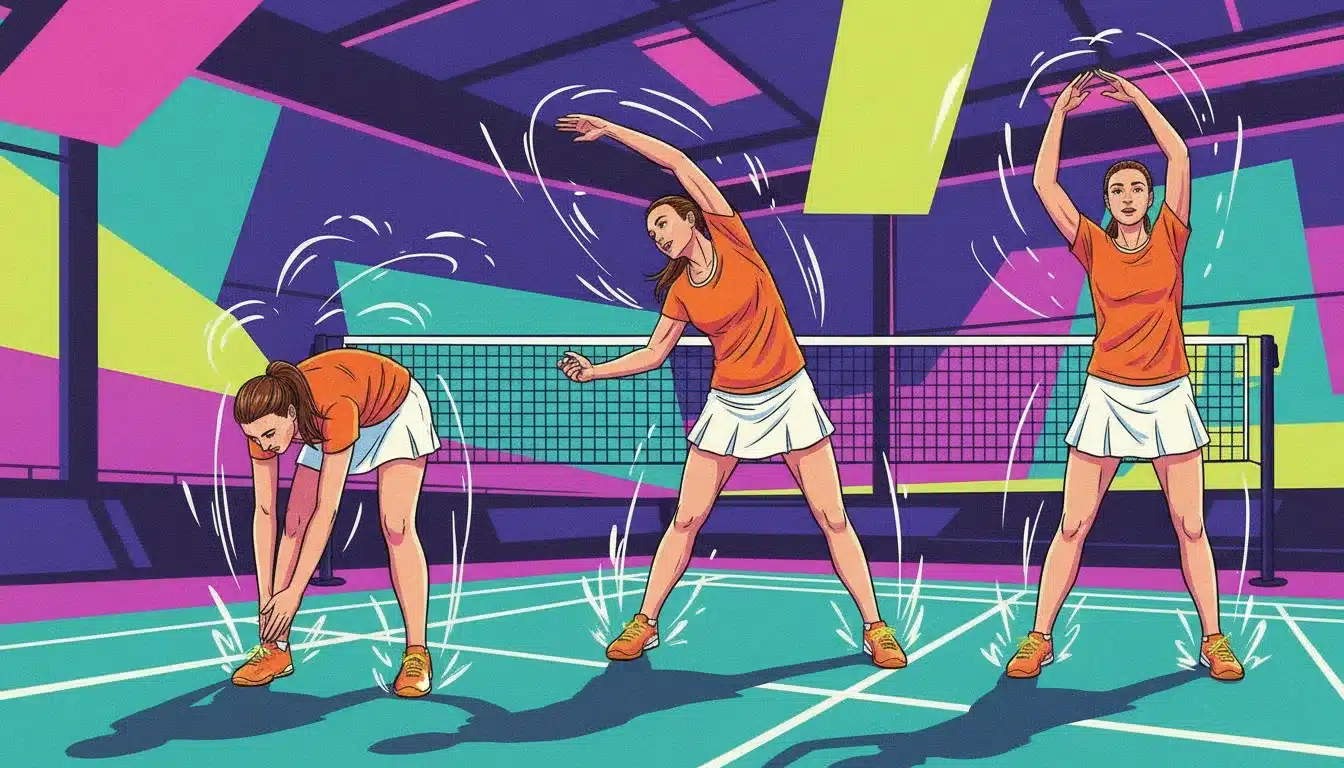

Warming up is the essential first step of any badminton session, whether for training or competition. Yet many players neglect it or execute it incompletely, exposing themselves to injury risks and limiting their on-court performance. In this comprehensive guide based on official BWF (Badminton World Federation) recommendations, we explain how to structure an optimal 10-15 minute warm-up that will prepare your body and mind for the specific demands of badminton.
Why Is Warming Up Essential in Badminton?
Badminton is one of the fastest sports in the world, with shuttlecocks reaching over 250 mph during powerful smashes. This discipline demands a unique combination of explosiveness, rapid direction changes, reactivity, and complex coordination. Without proper preparation, your body simply isn’t ready to meet these intense demands.
According to BWF coaching manuals, a well-designed warm-up provides six major benefits that literally transform your performance:
The 6 Key Benefits of an Effective Warm-Up
- Drastic reduction in injury risk: A cold muscle is 5 times more likely to tear than a warmed muscle. Sprains, strains, and ruptures can be prevented through progressive preparation.
- Increased blood flow to muscles: Muscle irrigation improves by 70-80%, enabling better delivery of oxygen and nutrients essential for performance.
- Elevated muscle temperature: Warm muscles contract faster and more efficiently, improving your reaction speed and explosiveness.
- Technical improvement: Badminton-specific movement patterns are reactivated and refined before play.
- Optimal mental preparation: The progressive transition from resting state to intense concentration allows you to be fully present mentally.
- Review of technical automatisms: You reactivate the essential technical gestures that will be required during the match or training.
The Structure of a Complete Warm-Up: The 5 Essential Phases
An effective badminton warm-up isn’t limited to a few running steps. It must follow a logical progression through 5 distinct phases, each targeting specific performance components. The recommended total duration is 10 to 15 minutes, adjustable according to ambient temperature, your practice level, and context (training or competition).
💡 Key Principle: Progressiveness
Each phase prepares the next with increasing intensity. Always start slowly and progressively increase the speed and range of motion. Your body needs this gradual transition to adapt to badminton’s demands.
1Phase 1: Cardiovascular Activation (3-5 minutes)
The objective of this first phase is to progressively increase your heart rate and elevate body temperature. This activation prepares your cardiovascular system for the upcoming intensity.
Duration and Intensity
- Duration: 3-5 minutes (reduce to 3 minutes in hot weather, increase to 5 minutes in cold weather)
- Intensity: Start at 50% of your maximum capacity, progressively increase to 70%
- Goal: Achieve light perspiration and accelerated but comfortable breathing
🏃 Exercise 1: Forward and Backward Running
Execution:
- Position yourself on the back court line, facing the net
- Run forward to the short service line (approximately 6 meters)
- Return backward to the baseline, still facing the net
- Repeat for 1 minute
Technical points: Keep shoulders parallel to the net, maintain upright posture, use shorter strides when moving backward. Forward running requires longer strides than backward running.
Benefits: Activates leg muscles, improves coordination of forward-backward movements specific to badminton, prepares calves and quadriceps.
⚡ Exercise 2: Lateral Chasse Steps
Execution:
- Stand at court center, facing the net
- Perform lateral chasse steps from one sideline to the other
- One foot “chases” the other but never completely catches it
- Keep hips low, as if skimming the floor
- Continue for 1-2 minutes alternating directions
Technical points: Keep head stable (imagine a net band you must not move), stay on the ball of your foot, maintain a regular rhythm. To verify quality execution, watch the net: if it appears motionless, your head stays at the same level.
Benefits: Prepares adductors and abductors, activates hip stabilizer muscles, improves lateral balance.
🔀 Exercise 3: Zigzag Movements
Execution:
- Use court lines as visual markers
- Perform chasse steps forming “Z” patterns across the court width
- Variation: add arm movements (rotations, swimming motions)
- Duration: 1-2 minutes
Technical points: Coordinate arm and leg movements, keep gaze forward, emphasize direction changes.
Benefits: Prepares for multidirectional direction changes, activates global coordination, warms muscles at different angles.
2Phase 2: Dynamic Joint Mobility (3-4 minutes)
This crucial phase prepares your joints for the large ranges of motion required in badminton. Dynamic mobility exercises are fundamentally different from static stretching: they involve controlled and progressive movements that “wake up” your joints.
⚠️ Common Mistake to Avoid
NEVER do static stretching at the beginning of your warm-up. Static stretching (holding a position for 30 seconds) on cold muscles can reduce performance and increase injury risk. They are reserved for cool-down. Always prioritize dynamic mobility during warm-up.
Principles of Dynamic Mobility
- Start with small amplitude movements and progressively increase
- Maintain control of the movement at all times (no bouncing or jerking)
- Focus on key joints: hips, shoulders, ankles, spine
- Maintain fluid and deep breathing
🦵 Exercise 1: Straight Leg Swing (Front-Back)
Execution:
- Balance on one leg, hands on hips
- Swing the other straight leg forward and backward in a controlled manner
- Start with reduced amplitude, progressively increase
- Keep torso and head motionless by fixing on a point ahead
- 10-15 repetitions per leg
Technical points: This exercise is excellent for dynamic balance provided the upper body stays stable. You can vary arm positions (arms raised overhead to increase difficulty).
Benefits: Mobilizes the hip, stretches hamstrings and hip flexors, improves dynamic balance on one leg.
↔️ Exercise 2: Lateral Leg Swing
Execution:
- Balance on one leg, hands on hips
- Swing the other straight leg laterally from left to right
- Progressive amplitude, controlled movement
- Keep hips facing forward and torso stable
- 10-15 repetitions per leg
Benefits: Prepares adductors and abductors for lateral lunges, mobilizes the hip in the frontal plane, strengthens lateral stabilizers.
🤸 Exercise 3: Dynamic Lunges with Rotations
Basic execution:
- Standing, feet together, hands on hips
- Take a large lunge forward with the right leg
- Front knee doesn’t pass toes
- Return to starting position and alternate with left leg
- 8-12 repetitions per leg
Advanced progression: Add trunk rotations during the lunge (turn left then right) or lateral tilts. This forces the body to maintain a stable base while the upper body moves.
Benefits: Prepares for playing lunges, mobilizes knees and hips, coordinates stretching of leg muscles, adds balance challenge with rotations.
🔄 Exercise 4: Trunk Rotations
Execution:
- Standing, legs shoulder-width apart
- Hold your racket in front with both hands
- Bend slightly at hips, then adopt semi-squat position
- Keep feet flat on the floor
- Perform trunk rotations left to right, hips facing forward
- 15-20 total repetitions
Benefits: Mobilizes the spine, prepares trunk muscles for explosive rotations, warms obliques and paraspinal muscles.
🙆 Exercise 5: Lateral Tilts with Racket
Execution:
- Standing, legs apart
- Hold racket overhead with both hands
- Keep hips facing forward (no rotation)
- Tilt trunk to one side then the other in controlled manner
- 10-15 repetitions each side
Benefits: Stretches lateral trunk muscles, mobilizes spine in frontal plane, prepares for lateral stretching during shots.
3Phase 3: Dynamic Balance and Coordination (2-3 minutes)
Dynamic balance is a fundamental motor component in badminton. According to BWF, it’s the ability for a player to maintain their center of gravity above a constantly changing base. A player with excellent dynamic balance moves with more stability, uses less energy, and performs technically at a superior level.
This warm-up phase activates proprioceptors (sensory receptors in your muscles and joints) that allow you to know where your body is in space, even without looking.
🧘 Exercise 1: Single-Leg Balance with Movement
Execution:
- Stand on one foot, other leg slightly raised
- Fix on a point ahead
- Perform arm movements (rotations, lateral raises)
- Advanced variation: close eyes for 10 seconds
- 30 seconds per leg
Technical points: Keep head motionless, engage ankle muscles, breathe normally.
Benefits: Activates proprioceptive system, strengthens ankle stabilizers, improves body awareness.
🦘 Exercise 2: Progressive Jumps
Progression:
- Level 1: Two-foot takeoff, two-foot landing (10 lateral jumps)
- Level 2: Two-foot takeoff, one-foot landing (8 repetitions per leg)
- Level 3: One-foot takeoff, two-foot landing (8 repetitions per leg)
- Level 4: Bounds (one-foot takeoff, opposite foot landing) – 6 repetitions
Technical points: Always land on ball of foot first, then lower heel. Cushion landing by bending knees.
Benefits: Prepares for badminton jumps and leaps, activates natural plyometrics, strengthens ankles and knees.
🎯 Exercise 3: Pivot and Shuttle Pickup
Execution:
- Place one foot on a floor mark (use a court line)
- Arrange 3 shuttles around you, accessible in lunge
- Lunge to pick up a shuttle
- Pivot on central foot (hop) to reposition
- Pick up all 3 shuttles then restart
- 2 sets per support leg
Benefits: Combines balance, lunge and pivot, reproduces badminton movement patterns, improves complex coordination.
4Phase 4: Speed, Agility and Reactivity (2-3 minutes)
Badminton demands exceptional speed and agility capabilities. Speed allows you to take the shuttle early and put your opponent under pressure. Agility, defined by BWF as “the ability to change direction rapidly while maintaining balance,” is essential on a relatively small court where situations evolve in fractions of a second.
📊 Performance Data
A study analyzed in BWF manuals reveals that top-level players reach 98% of their maximum heart rate during intense rallies. The ability to accelerate and decelerate rapidly makes all the difference between intercepting a shuttle or letting it pass.
⚡ Exercise 1: Ladder Work (or Sideline Drills)
Option A – With agility ladder:
- Place an agility ladder on the floor
- Perform different patterns: one foot in each square, two feet in each square, lateral steps
- 3 passes increasing speed
Option B – Without equipment (court lines):
- Use court sidelines as markers
- Perform 3 quick small steps (feet in-out-in)
- On the third time, your feet are outside and you sprint forward
- Return backward and restart
- 6-8 repetitions
Important instructions: Focus on very short ground contact (imagine the floor is hot), maintain rapid and regular rhythm, stay on ball of foot.
Benefits: Improves foot speed, develops foot-brain coordination, prepares for rapid direction changes.
🎾 Exercise 2: Shuttle Reactivity
Execution:
- Position yourself facing a partner or coach holding 8-12 shuttles
- They feed shuttles successively and rapidly in different directions
- You try to touch them with your hand (not racket)
- Advanced variation: use different colored shuttles, only hit the white ones
- 2 sets of 30 seconds
Benefits: Develops reaction time, improves hand-eye coordination, prepares for rapid reflexes needed at net.
🏃 Exercise 3: Sprint from Lying Position
Execution:
- Lie on your back in forecourt, feet toward short service line
- On signal, stand up as quickly as possible and sprint to baseline
- Variations: lying on stomach, arms crossed on chest (no arm assistance)
- 3-4 repetitions with 30 seconds recovery
Benefits: Develops explosiveness, simulates rapid recovery situations after a fall, activates maximum muscular reactivity.
5Phase 5: Specific Warm-Up with Shuttle (3-5 minutes)
This final phase integrates all previous elements into the real badminton context. You’ll now touch the shuttle and reactivate your specific stroke and movement patterns.
🎯 Context Adaptation Principle
According to BWF recommendations, shuttle warm-up must be adapted to context:
- Before a singles match: Cover entire court surface, practice all basic shots
- Before a doubles match: Include body shots, work specific doubles serves and returns
- Before training: Focus on elements that will be worked in the main session
Recommended Progression for Shuttle Warm-Up
Step 1: Backcourt Clears (1-2 minutes)
Execution:
- Start with high, slow clear exchanges
- Progressively increase speed and power
- Focus on technical quality and fluidity
Objective: Reactivate overhead stroke, warm shoulder, work backcourt movements.
Step 2: Shot Variations (1-2 minutes)
Execution:
- Integrate drops from backcourt
- Add midcourt drives
- Practice some net shots (net kill, lift)
- Vary trajectories and hitting zones
Objective: Wake all stroke types, prepare tactical variety, refine shuttle touch.
Step 3: Serves and Returns (1 minute)
Execution:
- Practice 4-5 short serves
- Practice 4-5 long serves (or flick serves for doubles)
- Work corresponding returns
- In doubles: emphasize specific serve-return situations
Objective: Prepare the most important shot in the game, refine accuracy, activate concentration.
⏱️ Timing of Shuttle Warm-Up
Before competition: Finish your shuttle warm-up 5-10 minutes before match start. Too early and you cool down, too late and you’re rushed. Use these last minutes for mental preparation and tactical visualization.
Adapting Your Warm-Up According to Context
An effective warm-up isn’t a rigid routine but a flexible structure that adapts to several factors. Here’s how to modulate your preparation according to different situations:
| Factor | Recommended Adaptation |
|---|---|
| Ambient Temperature | Hot weather: Reduce cardiovascular phase to 3 minutes, hydrate more Cold weather: Extend to 5 minutes, add clothing layer during warm-up |
| Practice Level | Beginners: Prioritize phases 1-2-5, simplify complex exercises Intermediate/Advanced: Execute all 5 complete phases with high progressive intensity |
| Time of Day | Morning: Stiffer body, extend mobility and activation (+2-3 minutes) Afternoon/Evening: Body already active, standard warm-up sufficient |
| Session Type | Technical training: Emphasize phases 2-3 (mobility and coordination) Physical training: Focus on phases 1-4 (cardiovascular and agility) Match: Balance between all phases, finish with specific shadow |
| Game Format | Singles: Shuttle warm-up over full court, long movements Doubles: Include body shots, flick serves, formation positioning |
Common Mistakes to Absolutely Avoid
Even experienced players sometimes make mistakes that compromise their warm-up effectiveness. Here are the most frequent pitfalls and how to avoid them:
❌ Mistake #1: Warm-Up Too Short
The trap: Limiting yourself to 3-4 minutes of light running and a few stretches.
The consequences: Insufficiently prepared muscles, multiplied injury risk, limited technical performance at match start.
The solution: Respect the recommended 10-15 minutes. It’s an investment, not a waste of time. Professionals warm up 20-30 minutes before important matches.
❌ Mistake #2: Static Stretching at Start
The trap: Starting with static stretches held 30 seconds on cold muscles.
The consequences: Reduction in muscle strength by 5-10%, decreased explosiveness, increased micro-tears.
The solution: ALWAYS reserve static stretching for cool-down. During warm-up, practice only dynamic mobility.
❌ Mistake #3: Intensity Too High Too Fast
The trap: Starting warm-up at 80-90% maximum intensity.
The consequences: Premature fatigue, energy reserve depletion, nervous system over-stressed before match even begins.
The solution: Respect progressiveness: 50% → 60% → 70% → 80% → playing intensity. Each phase prepares the next.
❌ Mistake #4: Neglecting Mental Preparation
The trap: Focusing solely on physical aspect while staying distracted (phone, conversations).
The consequences: Entering match without mental focus, prolonged adaptation time, first rallies lost.
The solution: Use warm-up as mental transition. Visualize your tactics, breathe consciously, progressively concentrate on upcoming play. As explained in our guide on mental preparation in badminton, mindset is as important as physical state.
❌ Mistake #5: Identical Routine Regardless of Situation
The trap: Applying exactly the same warm-up for technical training and a tournament final.
The consequences: Preparation inadequate to specific demands, energy waste or insufficient preparation.
The solution: Adapt your warm-up to context (see previous table). Preparation intelligence is part of performance.
Cool-Down: The Other Half of the Equation
If warm-up prepares your body for effort, cool-down is equally crucial for optimizing recovery and preventing long-term injuries. Yet this phase is often completely neglected by amateur players.
According to official BWF recommendations, an effective cool-down has two essential components:
Component 1: Aerobic Exercise at Decreasing Intensity (5-10 minutes)
Objective: Progressively return heart rate and blood pressure to resting level, eliminate lactic acid accumulated during effort.
Execution:
- Start with very light jogging around the court (2-3 minutes)
- Progressively reduce intensity to slow walk
- Finish with 2-3 minutes of normal walking
- Alternative: stationary bike at low resistance
Scientific benefits:
- Helps eliminate fluids and toxins accumulated in and around muscles
- Drastically reduces likelihood of post-effort dizziness or fainting
- Lactic acid transported to liver can be reconverted to energy source
- Reduces muscle soreness in following days by 30-40%
Component 2: Static Stretching (5-10 minutes)
Objective: Return muscles to their normal resting length, prevent progressive shortening of muscle fibers.
Correct static stretching technique:
- Duration: Hold each stretch 15-30 seconds (no less, no more)
- Intensity: Slight tension, never sharp pain
- Breathing: Deep and regular, exhale while entering stretch
- Repetitions: 2-3 passes per muscle group
Priority muscle groups in badminton:
- Calves (gastrocnemius and soleus): Heavily stressed during movements and leaps
- Hamstrings (back of thighs): High-risk area for tears in badminton
- Quadriceps (front of thighs): Power for lunges and jumps
- Adductors (inner thighs): Often neglected but essential for lateral lunges
- Glutes: Key hip stabilizers
- Shoulders and pectorals: Heavily stressed in overhead shots. For more prevention advice, consult our detailed article on injury prevention in badminton.
- Triceps: Explosive stroke muscle
- Back muscles: Rotations and postural maintenance
🔬 Why Static Stretching AFTER Exercise?
Static stretching during cool-down prevents progressive muscle shortening which, over time, can lead to altered technique and increased injury risks. It’s an investment in your sporting longevity. The more intense the exercise, the more important this phase is to allow the body to return to resting state in a controlled manner.
Frequently Asked Questions About Badminton Warm-Up
A complete warm-up should last between 10 and 15 minutes according to BWF recommendations. This duration can be modulated according to ambient temperature (reduce to 10 minutes in very hot weather, increase to 15 minutes in cold weather), your practice level, and session type (match or training). Professional players typically warm up 20-30 minutes before important matches.
Yes, the first 4 phases of a complete warm-up (cardiovascular activation, joint mobility, balance/coordination, speed/agility) are done without a shuttle and represent 7-10 minutes. You can complete with shadow movements that reproduce badminton movement patterns. However, for optimal preparation before a match, it’s strongly recommended to include 3-5 minutes of shuttle warm-up to reactivate your stroke automatisms and refine your touch.
No, static stretching (holding a position 15-30 seconds) should NEVER be practiced before exercise. Scientific research shows it reduces muscle strength by 5-10% and decreases explosiveness. Before exercise, practice only dynamic joint mobility (controlled and progressive movements). Reserve static stretching for cool-down, after training or match, when your muscles are warm.
If you’re truly time-constrained, prioritize in this order: 1) Cardiovascular activation (3-4 minutes minimum) to increase body temperature and blood flow, 2) Dynamic joint mobility (2-3 minutes) targeting hips, ankles and shoulders, 3) A few progressive shuttle rallies (2-3 minutes). This represents a minimum of 7-10 minutes. Below this threshold, you expose yourself to increased injury risk. Better to arrive 15 minutes early and warm up properly than rush this crucial phase.
The first 4 phases are identical for singles and doubles. The difference occurs during phase 5 (shuttle warm-up). In singles, you must cover the entire court surface with long movements and backcourt clears. In doubles, shuttle warm-up should include body shots (midcourt interceptions), specific doubles short and flick serves, and return-of-serve situations. Also dedicate some rallies to working in formation with your partner if playing as a team.
In cold weather, your warm-up should be longer (15-18 minutes) and more progressive. Wear an extra clothing layer during the first phases and remove it progressively. Extend the cardiovascular activation phase to 5-6 minutes. Pay particular attention to ankles and knees which are more vulnerable in cold. Emphasize dynamic joint mobility. If playing in an unheated gym, keep a tracksuit between matches and do a mini warm-up reminder (3-4 minutes) before resuming.
The first 4 warm-up phases (cardiovascular activation, mobility, balance/coordination, speed/agility) can be performed alone without any problem. For phase 5 (shuttle warm-up), a partner is ideal but you can adapt: practice shadow movements reproducing all stroke types, work your serves alone, or use a wall for simple rallies. Some professional players complete their solo warm-up with 10-15 minutes of very intense shadow to activate all movement patterns.
Before a match, warm-up must be complete and cover all 5 phases to prepare your body for maximum intensity and all situation types. The shuttle phase should reproduce match conditions (full court surface in singles, complete doubles situations). Before specific technical training, you can adapt warm-up to session content: if you’ll only work net shots, emphasize ankle mobility and forecourt movements, then focus shuttle warm-up on this zone. Training warm-up can be slightly shorter (10 minutes vs 15 minutes before match).
In badminton, warm-up should prioritize: 1) Ankles and calves (stressed at every leap and direction change), 2) Knees and quadriceps (repeated lunges), 3) Hips and hamstrings (large range of motion, high-risk injury area), 4) Shoulders and rotator cuff (repeated overhead shots), 5) Trunk and stabilizer muscles (explosive rotations). A complete 5-phase warm-up naturally activates all these muscle groups in a logical and progressive order.
Conclusion: Warm-Up, Your First Competitive Advantage
In a sport where matches are decided by details and where an injury can keep you off courts for weeks, warm-up isn’t an option but an absolute necessity. The 10-15 minutes invested before each session are among the most profitable of your badminton practice.
A warm-up structured according to the 5 BWF-recommended phases brings you:
- A massive reduction in injury risk (up to 50% according to some studies)
- An immediate improvement in your technical, physical and mental performance
- An optimal preparation of your cardiovascular system for badminton’s intense demands
- An activation of all your systems (muscular, articular, nervous, mental)
- A competitive advantage over opponents who neglect this phase
Alongside your warm-up, don’t forget to work on other performance pillars: master fundamental movement patterns that determine your ability to reach every shuttle, and integrate badminton-specific physical training principles into your weekly training.
Your challenge for the next session: Arrive 15 minutes before scheduled time and execute the 5 warm-up phases described in this article. Observe the difference in your playing level from the first rallies. Your body will thank you, and your opponents will notice the difference.
Warm-up isn’t a chore, it’s your preparation ritual for performance. Make it a non-negotiable habit, and you’ll permanently transform your badminton practice.