

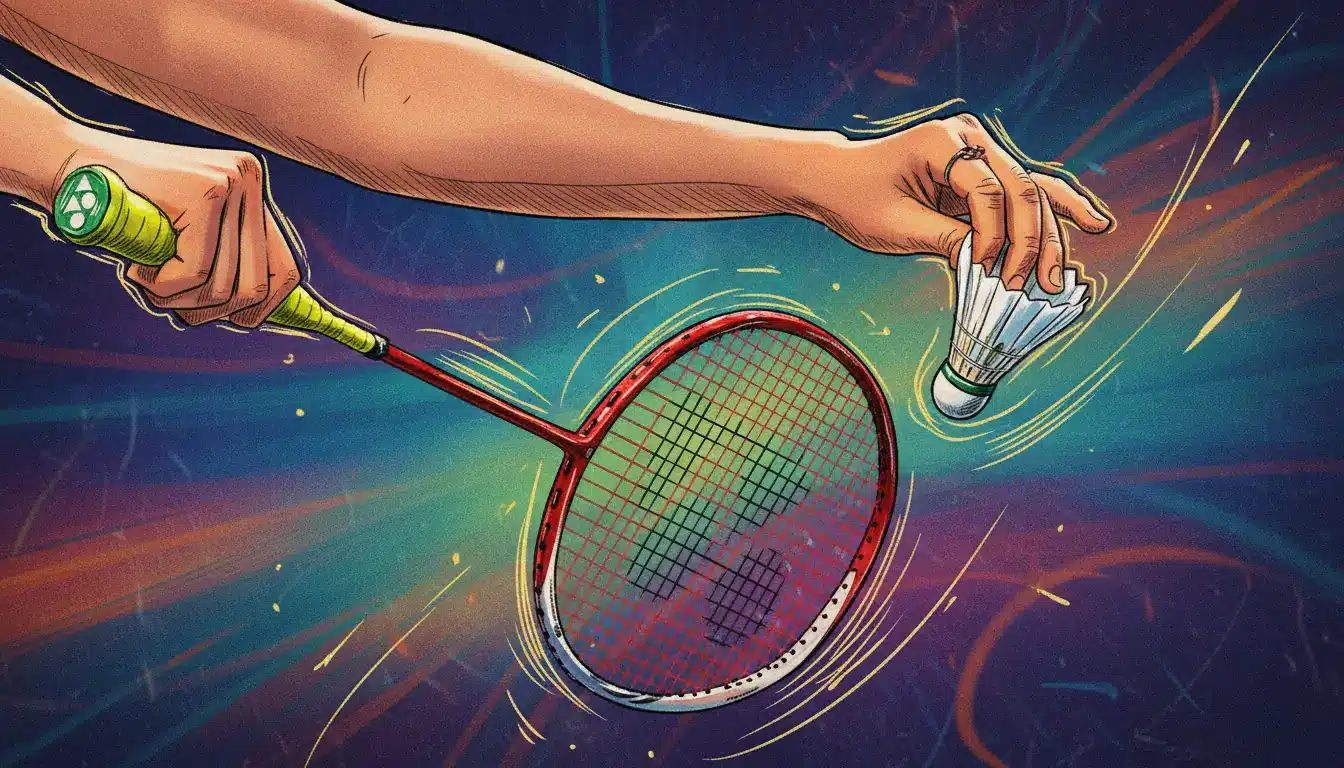

There’s only one shot in badminton that you have complete control over. One moment when your opponent can do absolutely nothing. One instant where you dictate all the rules of the game.
That shot is the serve.
Unlike every other shot where you must react to what your opponent does, the serve gives you absolute control. You choose the timing, trajectory, speed, and placement. It’s the only shot where you have 100% initiative.
Yet how many players neglect their serve? How many just send the shuttlecock “somewhere” over the net without any real strategy?
According to the Badminton World Federation, a low service error percentage is a fundamental prerequisite for winning a match.
But beyond simply avoiding faults, a mastered serve can give you a decisive advantage from the very first shot of the rally.
In this comprehensive guide, we’ll explore everything you need to know about badminton serving: from official rules to advanced techniques, from tactical strategies to specific training drills. Whether you’re a beginner looking to understand the basics or an advanced player wanting to perfect your secret weapon, you’ll find here the keys to transform your serve into a competitive advantage.
Official Service Rules (2025 Updates)
Before discussing technique and tactics, it’s essential to master the rules of serving. A service fault means losing a point before the rally even begins. BWF rules are precise and strict.
Fundamental BWF Rules
Badminton regulations impose specific constraints that distinguish the serve from all other shots:
The strike must be below waist level. Unlike tennis where serves are overhead, badminton requires an underhand strike. More precisely, the entire shuttlecock must be below the server’s waist at the moment of impact. The waist is defined as an imaginary line at the level of the server’s lowest rib, which corresponds approximately to elbow level when arms are hanging by the side.
Following recent regulatory updates, the maximum contact height is now fixed at 1.15 meters from the floor, a standardized measure that facilitates officiating and eliminates ambiguities.
The racket shaft must point downward. When striking the shuttlecock, your racket shaft must be oriented downward, with the racket head not being above your hand holding the grip. This rule ensures the serve remains an underhand shot.
You must hit the cork first. The racket must first touch the base (cork) of the shuttlecock, not the feathers. This rule exists because a pair of players once won a championship by hitting the feathers first, creating a random and nearly impossible-to-return trajectory. Since then, the BWF instituted this strict rule.
The motion must be continuous and uninterrupted. Once you’ve started the service motion, it must be smooth and uninterrupted until striking the shuttlecock. You cannot pause, deliberately slow down, or stop your motion. Any interruption constitutes a fault.
No undue delay. According to clause 9.1.1 of the Laws of Badminton, neither side shall cause undue delay to the delivery of service once the server and receiver are ready. From the first backward movement of the server’s racket head, any delay is considered undue. Umpires are now particularly attentive to side-to-side swaying motions or excessive hesitations.
Feet must remain on the ground. Part of each foot of both server and receiver must remain in stationary contact with the court surface from the start of service until its delivery. You cannot completely lift a foot before striking the shuttlecock. Additionally, no foot may touch the court lines.
Service must be diagonal. You must serve into the diagonally opposite service court. If the score is even (0, 2, 4, etc.), you serve from the right side; if the score is odd (1, 3, 5, etc.), you serve from the left side.
Service zones vary by discipline. In singles, the service court is long and narrow (the back boundary line is valid, but not the side tramlines). In doubles, the service court is short and wide (the side tramlines are valid, but not the area beyond the back service line).
Special rule: “spin serve” prohibition. Since May 2023, the BWF instituted an experimental variation banning the “spin serve” (extended through January 1, 2025). The server must release the shuttlecock without adding spin.
Different Types of Serves
Badminton serving isn’t a single shot, but a palette of tactical variations. Each serve type has its characteristics, uses, and specific advantages.
The Short Serve (or Low Serve)
This is the most commonly used serve in doubles and increasingly frequent in singles at high levels. The objective is to make the shuttlecock pass just over the net with the flattest possible trajectory, so it drops quickly just behind the short service line.
Why the short serve is effective: It forces the opponent to hit upward, immediately removing their offensive initiative. If executed well, your opponent can only lift the shuttlecock, giving you the opportunity to take control of the rally from the second shot.
Backhand short serve technique: Most high-level players use the backhand short serve because the distance between racket and net is shorter than with a forehand. With the contact point closer to the net, the opponent has less time to react and prepare.
The racket grip is fundamental: place your thumb flat on the wide part of the grip, as if waiting for a backhand defensive shot. The shuttlecock is held delicately between the thumb and index finger of your free hand.
The motion is short and controlled: a small wrist and forearm movement suffices. The goal is precision, not power. The shuttlecock should pass a few centimeters above the net and drop quickly.
Positioning for short serve: In doubles, the server positions very close to the short service line, directly on the T. This position allows them, if the opponent plays a short return, to lunge forward with a simple step to intercept the shuttlecock. If the opponent plays long, the partner covers the back of the court.
Short serve variations: You can vary lateral placement (toward the body, toward the center T, toward the sideline) and height (skimming the net to force a lift, slightly higher to create uncertainty).
The Long Serve (or High Deep Serve)
Primarily used in singles, the long serve aims to send the shuttlecock as high and far as possible, so it drops perpendicularly close to the back boundary line.
Tactical objective of the long serve: Force the opponent to retreat quickly and hit the shuttlecock from an unfavorable position at the back of the court. A good long serve must force your opponent to hit while moving backward or off-balance, thus limiting the power and precision of their return.
Forehand long serve technique: This is generally executed with a forehand, as it allows more natural power generation.
The shuttlecock is held by the thumb and index finger of your free hand, at hip height. You let it drop slightly to the right side of your body (for a right-hander).
The racket is brought far back during the backswing, creating a large amplitude of movement. The arm then accelerates close to the front leg, generating speed and power.
Weight transfer is crucial: your weight starts on the back foot (right for a right-hander), then you lean forward during the backswing, and your weight ends on the front foot (left) at the moment of striking.
Foot placement: the left foot (for a right-hander) is parallel to the center line, while the right foot forms an angle up to 90°. During the movement, the hips pivot forward and to the right.
Optimal trajectory: The shuttlecock should rise high, exploiting the full height of the gymnasium, to descend almost vertically. This trajectory makes smashing difficult for the opponent and gives them fewer attacking angles.
Strategic placement: Aim close to the center line at the back of the court. This opens fewer angles for the opponent and forces them to play a diagonal return potentially within your reach.
The Flick Serve (or Drive Serve)
The flick serve is a fast, flat attacking serve designed to surprise an opponent who has moved too far forward or is too confident in their ability to “kill” a short serve.
When to use the flick serve: It’s a tactical variation shot. If you’ve served short several times and notice your opponent beginning to anticipate by advancing their racket above the net, the flick serve can catch them off guard.
The shuttlecock is struck with sudden acceleration and passes quickly above the opponent’s racket who was expecting a short serve. The trajectory is relatively flat but ascending, generally aiming for the back of the service court.
Risk/reward aspect: The flick serve carries significant risk. Since the shuttlecock’s trajectory remains in the opponent’s action zone (unlike the long serve which rises very high), an attentive and reactive opponent can intercept the shuttlecock and smash it forcefully, immediately putting you in difficulty.
Experienced players quickly recognize the signs of a flick serve after two or three attempts and can anticipate to counter violently. This is why this serve must remain exceptional, used sparingly only as a tactical variation.
Flick serve placement: Side flick serves (toward the court sides) are often more difficult for the receiver to handle, particularly on the forehand side. According to BWF tactical principles, these side serves often lead to a predictable straight return that the server’s partner can anticipate in doubles.
Why Does the Backhand Serve Dominate?
A common question: why do the vast majority of professional serves, particularly in doubles, use the backhand?
The answer is simple: distance and reaction time.
With a backhand grip, the contact point between racket and shuttlecock is naturally closer to the net than with a forehand. This difference may seem minimal – a few dozen centimeters – but at this level of precision, it’s decisive.
Since the shuttlecock is struck closer to the net, it travels a shorter distance before reaching the opponent. This fraction of a second less gives your opponent less time to prepare, adjust, and decide their return.
Additionally, the backhand backswing is naturally shorter and more discreet than a forehand backswing, making it more difficult for the opponent to anticipate whether you’ll serve short or attempt a flick serve.
This efficiency explains why, at elite level, the backhand serve predominates in both singles and doubles. Only women’s singles players are an exception, sometimes preferring the forehand to generate the power needed for long serves to the back of the court.
Service Strategies and Tactics
Serving isn’t just about technique – it’s primarily a tactical tool. How you serve must adapt to the discipline you’re playing, your opponent’s style, and the match situation.
Singles Service Tactics
In singles, the server must cover the entire court alone. This reality profoundly influences service strategy.
Server positioning in singles: Unlike doubles where the server stands right against the short service line, in singles the server positions approximately one meter back. Why? Because they must be able to handle both a short return and a long return, without a partner’s help.
Standing slightly back allows better coverage of deep returns while remaining capable of moving forward if necessary.
Serving from the center line: Serve as close as possible to the center line. This position allows you to quickly return to your base position (the T) after serving. If you serve from the court extremes, you’ll have to cover a greater distance to regain a balanced defensive position.
Variation between short and long: The key in singles is to constantly vary between short and long serves, preventing the opponent from anticipating. However, at high level, the long serve to the back of the court is favored, as it forces the opponent to cover a greater distance and hit from a disadvantageous position.
A well-placed long serve close to the back line, on the center line, opens few angles for the opponent and can generate a weak diagonal return, potentially within your reach for an interception.
Avoid smashing from the back court: If your opponent returns your long serve with a defensive clear that places you at the back of the court, avoid smashing from this position. The shuttlecock loses too much speed over such a distance and arrives relatively slowly at the opponent. Moreover, to achieve the necessary downward angle, you must hit very hard and very high, which is energy-consuming and risky. Prefer smashing from mid-court.
Adapt to opponent’s profile: Carefully observe how your opponent positions themselves to receive serve. If they stand wide in the middle of the court, the short serve becomes your best option – they’ll have to execute a significant lunge to reach the shuttlecock and can only lift with an underhand shot.
Conversely, if your opponent stands very close to the net, racket high above net level waiting to “kill” a short serve, then the long serve (or flick serve) becomes imperative. An opponent in this position can easily intercept and attack a short serve that’s too high.
Doubles Service Tactics
Doubles is a game of attack and speed. Rallies are faster, spaces more restricted, and each team seeks to seize offensive initiative as early as possible.
The short serve dominance: In doubles, the short serve reigns supreme. The objective is clear: force opponents to lift the shuttlecock, immediately creating an attacking opportunity for your team.
Offensive formation after short serve: When you serve short in doubles, you must immediately prepare to cover all net returns. Your partner, meanwhile, positions themselves responsible for mid-court and back court.
This “front-back” formation (or “offensive rotation”) puts you in position to intercept any weak return or any net shot, while your partner can smash lifted returns.
The server must anticipate: After serving short, prepare to preferentially cover one side. If you serve straight (parallel to the sideline), position yourself to intercept straight returns. If you serve cross-court, anticipate cross-court returns.
This anticipation allows you to react faster and put pressure on the receivers from the start of the rally.
The flick serve as variation: The flick serve can be used in doubles to prevent receivers from anticipating too much and advancing their position too far. A well-placed flick serve, particularly to the sides, can unbalance the receiver and create a weak return.
However, as we’ve seen, it’s a risky shot that should remain an occasional variation rather than a main weapon.
Mixed Doubles Service Tactics
Mixed doubles presents a unique dynamic where physical differences between men and women influence tactics.
Zone distribution: The man, generally more powerful and faster in power-speed, covers the back of the court and assumes offensive responsibilities (smash, attacking drop). The woman covers the front right of the court, specializing in net play and quick interceptions.
Service position in mixed: Whether the woman or man serves, the woman must position herself at the front on the short service line from the start of the point. This formation allows the woman to quickly return to the net after serving to cover her zone.
Serves toward the opposing woman: When serving toward the opposing woman in mixed, the flick serve is particularly used. This serve forces the woman to retreat quickly, and if her male partner must intervene to hit the shuttlecock at the front of the court, both opponents find themselves in tactically unfavorable positions.
The objective is to create a situation where the woman must either smash or drop from the back (which generally isn’t her strength), or force the man to abandon his offensive position at the back of the court.
Common Mistakes to Avoid
Even among advanced players, certain service errors persist. Identifying and correcting them can immediately improve your game’s effectiveness.
Serving too high when attempting a short serve
This is the classic beginner mistake when trying to make a short serve: from fear of touching the net or lack of confidence in touch, the shuttlecock passes too high above the net.
Result: a “gift” serve that the opponent can easily intercept and attack with an immediate winning shot. At high level, a short serve that’s too high is systematically punished.
The solution: train specifically on height control. Place a rope or elastic parallel to the net at 10-15 cm above it and aim to pass the shuttlecock between the net and this rope. Repeat this exercise until you develop the necessary touch.
Lacking variation
Always serving to the same place, always in the same manner, means allowing your opponent to anticipate perfectly and prepare accordingly.
According to the BWF, the server has the advantage in badminton – they have the active role while the opponent can only react. But this advantage disappears if you’re predictable.
Systematically vary your serves: alternate short and long, change lateral placements, slightly modify height. Keep your opponent uncertain.
Neglecting opponent observation
Too many players serve “on autopilot” without watching how their opponent positions themselves to receive.
Observe carefully: are they very advanced near the net? Serve long or flick. Are they standing in the middle of the court? Serve short. Do they favor one side? Exploit their opposite weakness.
Observation and adaptation are essential tactical skills that transform a technical serve into a strategic weapon.
Training Drills to Perfect Your Serve
Serve mastery is only acquired through repeated and targeted practice. Here are progressive drills recommended by BWF training programs.
Place targets (hoops, markers, zones marked with tape) just behind the short service line, in different zones: near the T, on the sides, etc.
Objective: Successfully land 10 consecutive serves in each target zone.
Progression: Start with wide targets (1m x 1m), then gradually reduce their size until aiming for 50cm x 50cm zones.
This drill develops precision and repeatability of your short serve.
Set up a rope or elastic parallel to the net, approximately 10-15 cm above it.
Objective: Pass 20 serves between the net and the rope, without touching either.
This drill forces you to develop fine touch and precisely control the shuttlecock’s trajectory.
Serve alternately: one short serve, then one long serve, then short, then long.
Objective: Successfully complete 20 consecutive serves without fault, alternating both types.
This drill forces you to constantly change technique and power, developing your ability to vary in matches.
Play a match where only serves count. Each successful serve in a determined zone earns 1 point, each fault loses 1 point.
First to 21 points wins.
This drill recreates real match pressure and teaches you to serve under stress.
Organize a doubles match with a special rule: if the serving team wins the rally on the 3rd shot (winning shot by the server or their partner on the service return), they score 2 points instead of 1.
This drill, recommended by the BWF, pushes you to serve offensively and immediately seek dominance after serving.
The server must announce before serving which zone they’ll place their serve in (example: “short right side”, “long center”, “flick outside left”).
The receiver therefore knows the zone but must still return effectively.
Objective: Successfully place the serve exactly where announced, even though the opponent knows.
This drill develops absolute precision and confidence, as you must succeed with your serve even when your opponent is prepared.
Set progressive objectives:
- 50 serves without fault
- 100 serves without fault
- 200 serves without fault
As soon as a fault occurs, start over from zero.
This brutal drill develops concentration, mental endurance, and technical consistency.
The Psychological Importance of Serving
Beyond pure technique, serving possesses a psychological dimension often underestimated.
Confidence and Routine
Serving is the only moment when you totally control the game. It’s therefore also the moment when your confidence (or lack thereof) manifests most clearly.
Developing a consistent pre-serve routine helps manage stress and enter an optimal mental state. This routine can include: breathing deeply, visualizing the desired trajectory, always adopting the same sequence of preparatory movements.
Pressure and Critical Points
At 20-20 in the deciding set, your serve can make the difference between victory and defeat. Players who have trained their serve until it becomes automatic can reproduce it even under extreme pressure.
Those who neglect serving in training find themselves in difficulty at crucial moments, when stress amplifies every technical weakness.
Imposing Your Rhythm
A confident server imposes their rhythm on the match. They don’t rush, take time to position correctly, breathe, and serve when ready.
Conversely, a hesitant or rushed server gives the impression of being nervous, which boosts the opponent’s confidence.
Conclusion: The Serve, Foundation of Your Game
The serve is much more than just a shot to put the shuttlecock in play. It’s your first opportunity to impose your strategy, dictate the rhythm, and put the opponent in difficulty.
It’s the only shot where you have 100% control, without opponent pressure. This particularity makes it both a responsibility and an extraordinary opportunity.
A mastered serve becomes a formidable weapon. A neglected serve becomes a weak point that your opponents will systematically exploit.
The good news? The serve is probably the easiest shot to dramatically improve. It doesn’t require exceptional physical qualities – just technique, repetition, and tactical intelligence.
Invest time to perfect your different serve types. Train yourself to constantly vary. Observe your opponents and adapt. Develop a solid mental routine.
And remember: according to BWF experts, a low service error percentage is a fundamental prerequisite for winning. But don’t just settle for simply avoiding faults. Transform your serve into a competitive advantage, into a strategic weapon that gives you initiative from the very first shot of each rally.
The serve is where everything begins. Master it, and you’ll master the game.
Frequently Asked Questions About Badminton Serving
Sources and References
This article is based on official and authoritative sources in the badminton world:
All technical and regulatory information has been verified against official Badminton World Federation (BWF) standards, the world governing body for badminton, ensuring the accuracy and conformity of recommendations presented in this article.