

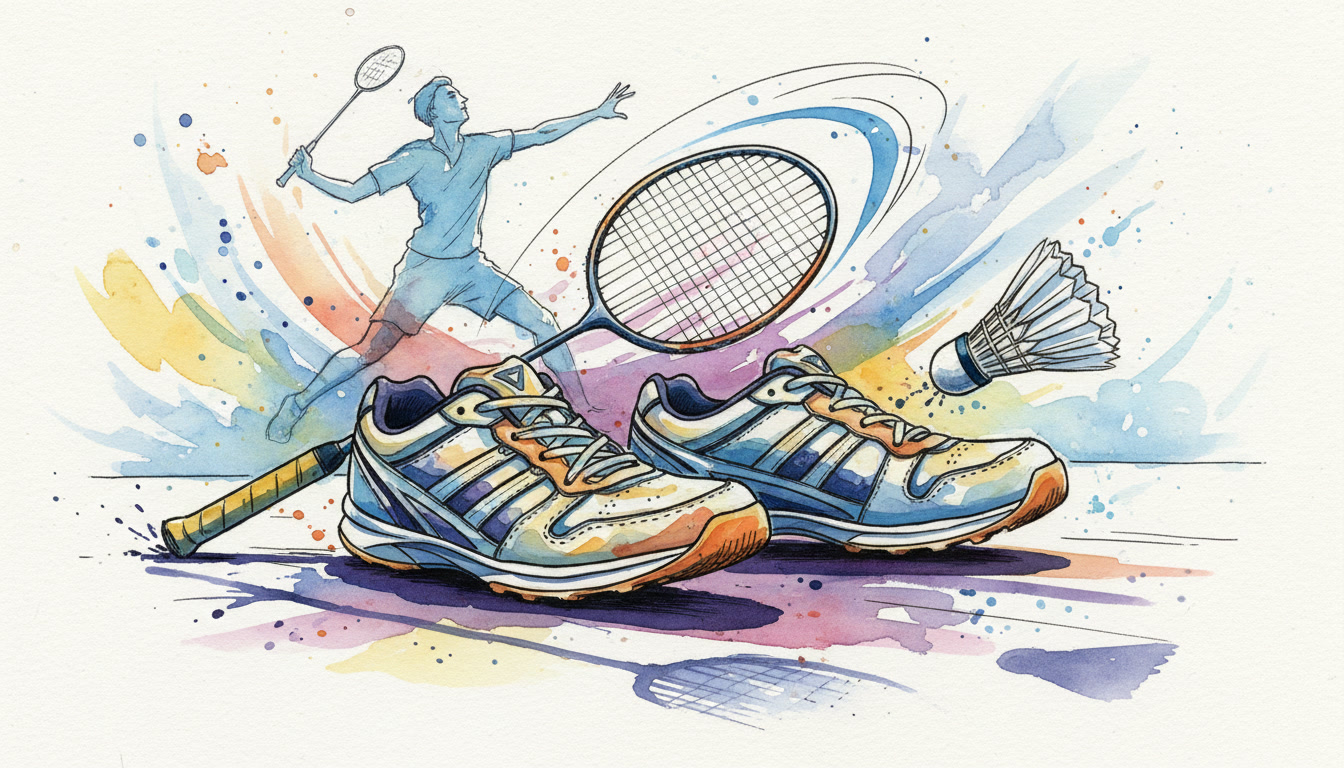

Choosing the right badminton equipment is crucial for progress and injury prevention. Contrary to popular belief, equipment is not limited to the racket: from the shuttlecock to shoes and strings, each element plays a vital role in performance and playing enjoyment. This guide relies on official Badminton World Federation (BWF) specifications and professional technical recommendations to help you make informed choices.
The Racket: Specifications and Characteristics
BWF Standards and Anatomy
Badminton rackets used in official competition must comply with BWF-established specifications. The frame can have a maximum length of 680 millimeters and a maximum width of 230 millimeters. A racket consists of five main parts: the head (frame), the frame, the shaft, the throat (T-joint), and the handle. The stringed area must be flat with a pattern of strings alternately interlaced where they cross.
Weight: From 2U to 5U
Competition rackets generally weigh under 100 grams (without strings). Manufacturers use a classification system popularized by Yonex that categorizes weights in 5-gram increments. A 2U racket weighs between 90-94 grams, a 3U between 85-89 grams, while a 4U ranges from 80-84 grams. The lightest rackets (5U) weigh less than 80 grams.
Weight choice directly influences maneuverability and power. Beginners often prefer lighter rackets (4U or 5U) to facilitate movements, while advanced players may opt for heavier models offering more power in shots.
Balance: Head-Heavy, Head-Light or Neutral
A racket’s balance determines weight distribution along the frame. A “head-heavy” racket concentrates weight toward the head, favoring smash power and suiting offensive baseline players. Conversely, a “head-light” racket improves maneuverability and suits defensive players favoring quick reactions at the net. Neutral balance offers a versatile compromise, ideal for progressing players or those with varied playing styles.
Balance measurement is taken from the bottom of the handle to the balance point where the racket would remain stable on a wire. Note: manufacturers sometimes measure this balance with or without grip, with or without strings, which can distort cross-brand comparisons.
Strings: The Element in Contact with the Shuttle
The Often Underestimated Importance
As professional stringers emphasize, in badminton you don’t hit the shuttle with the racket but with the strings. Strings influence approximately 50% of overall racket performance. Unsuitable strings prevent full exploitation of even high-end frame potential.
In badminton, only multifilament strings are used. Composed of multiple synthetic fiber strands, they offer flexibility and comfort. The main characteristics to consider are gauge (thickness), elasticity, and tension.
Gauge: From 0.61 to 0.74 mm
Gauge refers to string thickness, generally ranging from 0.61 to 0.74 millimeters. Thinner strings offer more feel and control thanks to increased space between strings allowing better spin. However, thin strings wear faster than thick strings.
Popular strings like Babolat I Feel come in several gauges: I Feel 70 (0.70 mm) for durability and feel, I Feel 68 (0.68 mm) for balance between feel and durability, and I Feel 66 (0.66 mm) for maximum control and precision.
Tension: The Crucial Parameter
String tension, expressed in kilograms (or pounds in English-speaking countries), can vary from 8 to 16 kilograms depending on player and racket. Factory-strung rackets typically display tension around 9-9.5 kilograms, which can lose up to 1 kilogram between factory and final purchase.
| Tension | Characteristics | Player Profile |
|---|---|---|
| 18-23 lbs (8-10.5 kg) | More power through “trampoline” effect, less control and precision | Beginners, recreational players, those lacking power, first restringing |
| 24-27 lbs (11-12.5 kg) | Balance between power and control, better repulsion | Intermediate players with progressing technique |
| Above 28 lbs (13 kg) | Maximum control, high precision, requires excellent technique | Advanced and professional players (pros never below 28 lbs) |
Replacement Frequency
Strings naturally wear even without playing, losing elasticity and quality over time. A regular player should change strings 3-4 times per year, while an intensive player may need monthly replacement. For beginners, replacement every 6-8 months is advised, with a minimum of once per year.
Signs indicating replacement is needed include loss of control, decreased shuttle repulsion, or simply visible string wear. Important tip: if strings break, cut them immediately even if you don’t plan to replace them soon, to prevent residual tension from damaging the frame.
Shuttlecocks: Feather, Plastic or Hybrid
BWF Specifications for Feather Shuttlecocks
According to official BWF specifications, a feather shuttlecock must be composed of 16 feathers fixed in a cork base. The feather tips must form a circle. The BWF certification program, introduced in 1988, ensures a satisfactory standard for shuttlecocks used in international competitions. The approved shuttlecock list includes manufacturers like Yonex, Victor, Li Ning, and several others certified for international play.
Feather Shuttlecocks: Excellence and Fragility
Feather shuttlecocks represent the absolute reference for competition and high-level play. Composed of 16 goose or duck feathers weighing approximately 5 grams, they are hand-made. Their so-called “parachute” trajectory is inimitable: the shuttle rises in a straight line then descends almost vertically, having lost all horizontal speed.
Goose feather shuttlecocks are superior to duck feather ones, offering better resistance thanks to their lower rigidity. Feather quality is graded from A to E, with grade A being highest. However, their lifespan remains limited, rarely beyond one match, which explains why professional players can consume up to 50 shuttlecocks during a single world-level match.
Feather Shuttle Speed
Feather shuttles come in 5 speeds, adapted to temperature and altitude conditions. The general rule states that the warmer it is, the slower the shuttle should be. In Europe, speeds 77 and 78 are primarily used.
| Speed | Recommended Temperature | Usage |
|---|---|---|
| 76 | Above 80°F (27°C) | Common in Asia, hot climates |
| 77 | 73-80°F (23-27°C) | European standard, normal speed |
| 78 | 61-72°F (16-22°C) | European standard, fast shuttle |
| 79 | Below 61°F (16°C) | Cold climates, very fast |
Plastic Shuttlecocks: Durability and Economy
Synthetic or plastic shuttlecocks are ideal for training, recreation, and beginners. Much more resistant and economical than feather shuttles, they offer a different trajectory, more parabolic and linear. Their flight is longer and more taut, with less marked deceleration after racket impact.
Plastic shuttles come in 3 speeds identifiable by a colored band on the base: green (slow, for beginners), blue (medium speed, standard for clubs and schools), and red (fast, for experienced players seeking speed). They are not approved for official competition but remain perfect for developing technique without breaking the bank.
Hybrid Shuttlecocks: The Best Compromise
Recently appearing in Europe, hybrid shuttlecocks combine a cork base with short high-quality feathers mounted on a composite plastic base. They offer trajectory close to feather shuttles with plastic shuttle durability, at an intermediate price. This innovation constitutes an excellent solution for clubs and intermediate players wishing to progress toward feather feel.
Shoes: Protection and Performance
Why Specific Shoes?
Badminton is extremely demanding on muscles and joints due to repeated footwork and sudden direction changes. Unsuitable shoes significantly increase risk of injuries such as sprains, tendinitis, or joint trauma. Moreover, to preserve gymnasium flooring, only indoor sport shoes are allowed.
Anatomy of a Badminton Shoe
A badminton shoe consists of five main parts. The outsole (outer sole) in rubber ensures floor grip and must resist wear. Its sculpting with flex lines allows dynamic and stable footwork. The midsole houses the most innovative cushioning systems (Yonex Power Cushion, Asics spEVA, Babolat OCS Tech) and structures the fit for comfort and stability. The insole (inner sole), generally removable, ensures comfort and breathability. The upper (top part) impacts support and size, often in 3D mesh for breathability. Finally, the lateral shield reinforces the inner zone to reduce wear during lunges.
The Four Shoe Profiles
Comfort
- Optimal cushioning to absorb shocks
- Thicker sole, better joint protection
- Adaptation to wide feet
- Ideal for players with injury history or heavy build
- Less dynamism but more security
Dynamism
- Thin sole for close-to-floor feel
- Repulsive materials (spEVA, OCS Tech)
- Maximum lightness and velocity
- Enhanced footwork precision
- For athletic, light players, narrow feet
- Less cushioning and comfort
Stability
- Integrated anti-torsion system
- Stability plate or bar
- Maximum foot security
- For fast players or fragile ankles
- Good cushioning with increased rigidity
- Slightly heavier
Versatility
- Balanced compromise without weaknesses
- Suited to all playing styles
- Good for progressing players
- Features present but not maximized
- No exceptional strengths
Choosing According to Morphology
Players of heavy build, tall, or prone to joint pain should favor shoes with maximum cushioning and good support if ankles are fragile. Light and athletic players with narrow feet can opt for dynamic models with thin soles. For regular practice, the ideal compromise combines cushioning and lightness with comfort and stability. In intensive practice, focus on friction resistance and dynamism to return energy during jumps.
Essential Accessories
Grip and Overgrip: The Racket Contact
Grip and overgrip play a crucial role in racket feel and control. Unlike tennis, badminton requires a relaxed racket grip, necessitating a rather thin handle to facilitate maneuverability and grip changes. Three product types exist: the grip (replacing the original grip directly on wood handle), the overgrip (placed over existing grip to adjust thickness), and the towel or sponge grip (in sponge to absorb perspiration, ideal for sweaty hands but requiring frequent replacement).
Synthetic grips are more durable and consistent but offer less grip in case of perspiration. Each player must adapt handle thickness to their morphology, knowing that too thick a handle harms rapid grip changes, essential in badminton.
The Badminton Bag
A good badminton bag must hold several rackets (generally 2-3 minimum), shuttle tubes, shoes, spare clothing, and accessories. Thermobag models protect strings from temperature variations that can affect tension. Favor bags with separate compartments to isolate dirty shoes from other equipment.
Clothing and Socks
Badminton clothing must be light, breathable, and allow total freedom of movement. Synthetic materials evacuating perspiration are preferable to cotton which retains moisture. Specific badminton socks, cushioned and reinforced in friction zones, prevent blisters during long sessions. A support band on the midfoot improves comfort.
Key Points to Remember
- BWF rackets have a maximum length of 680 mm and width of 230 mm
- Strings influence 50% of performance – don’t neglect them
- Increase tension gradually in 0.5 kg (1 lb) increments
- Feather shuttles are mandatory in approved competition
- Shuttle speed adapts to ambient temperature
- Specific badminton shoes are essential to prevent injuries
- Cushioning and stability are priority over lightness for most players
- Replace your shoes every 6-12 months depending on play frequency
- Grip directly influences game control and feel
Conclusion
Choosing badminton equipment should never be taken lightly. Each element, from racket to shoes including shuttle and strings, contributes to your performance, progress, and especially your health. By relying on official BWF specifications and adapting your equipment to your level, morphology, and playing style, you will maximize your enjoyment and minimize injury risks. Don’t hesitate to test different materials and seek professional advice to find the perfect combination that will allow you to express your full potential on court.