

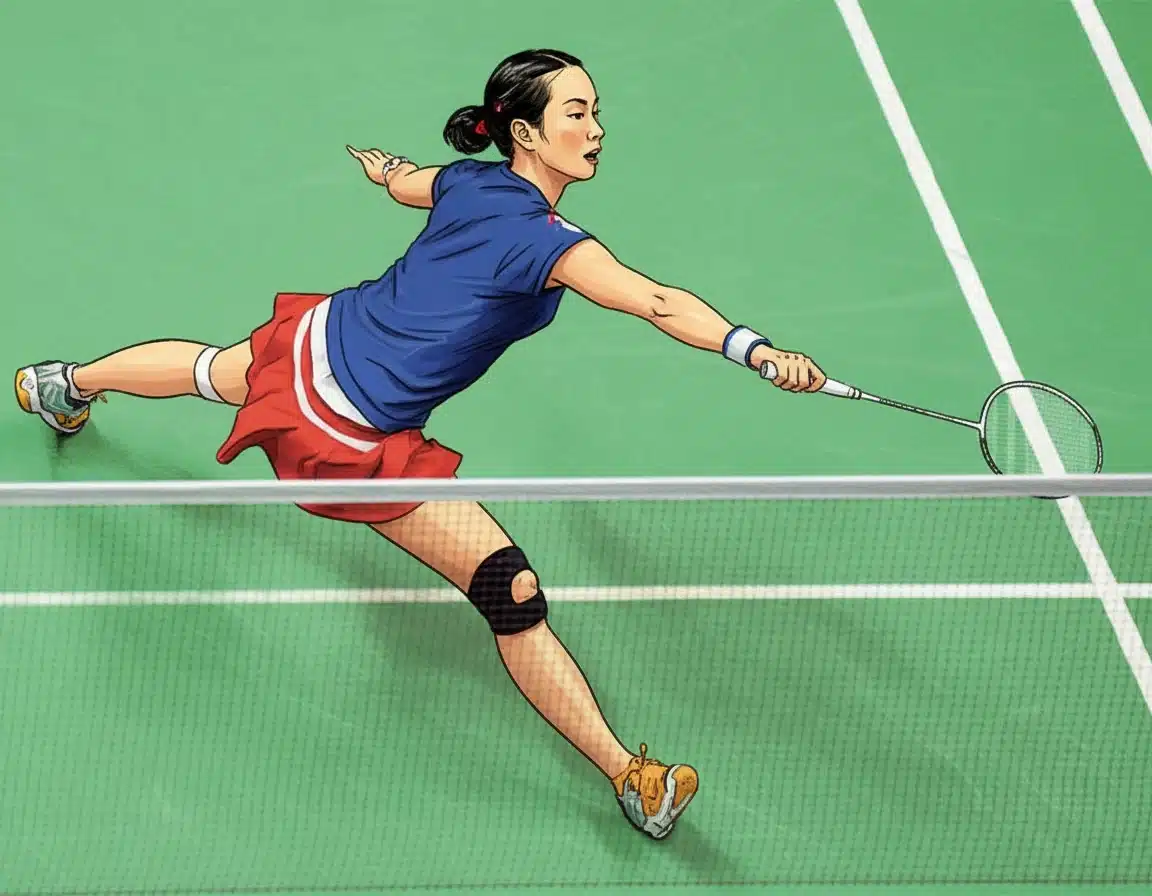

Many players believe that “improving” means hitting harder, moving faster, or training more hours. In reality, most points — especially in singles and men’s doubles — are not won through pure power. They are won through tactical intelligence: using your strengths, exposing your opponent’s weaknesses, and creating pressure without wasting energy.
These principles align with the tactical models described in the BWF Level 1 & Level 2 Coaching Framework, which show that at all levels of performance, decision-making and tactical structure account for the majority of points won.
🧩 Why Tactics Determine 80% of Your Points
Watch any club match and you’ll notice that most points come from four situations:
- a poor-quality return (short lift, floating clear, high net shot),
- late anticipation,
- poor positioning,
- a shot selection that doesn’t match the situation.
These observations match the findings of Phomsoupha & Laffaye (2015), who demonstrated that positioning errors and poor reading of the game account for a high proportion of points lost up to national level.
🎯 1. Mastering the 3 Pressure Zones
The structure of the court dictates your strategy. A simple yet powerful way to understand it is to divide the game into three pressure zones:
High, deep, long shots to push the opponent back and isolate them on one side.
Zone 2: Mid Court → Diagonal Pressure
The transition zone where rallies shift from neutral to attacking.
Zone 3: Front Court → Vertical Pressure
Net play, interceptions, and tight spinning shots — the zone that wins points.
This zone framework is also used in the BWF Coaching Manual, particularly in the sections dedicated to teaching pressure patterns and tactical decision-making. To dive deeper into managing attack, defense, and transitions, check our complete guide to badminton tactical situations.
🔎 2. The “Two-Shot Rule”: The Simplest and Most Powerful Tactical Tool
Most amateur players decide their next shot reactively. This limits their potential. A far more effective approach is to think in two-shot sequences — a preparation shot followed by a finishing shot.
Examples:
- Deep cross clear → tight net shot
- Mid-court lift (voluntary) → smash to the hip
- Fast net shot → interception on the next lift
The first shot moves or destabilises the opponent. The second punishes the space you’ve forced them to leave.
This “planned sequence” approach is emphasised in both FFBaD coaching education and the BWF Level 2 Coaching Manual, where the first shot is described as the “construction shot”.
🌀 3. Tempo: The Most Overlooked Element of Tactical Play
You control the pace of the rally — not your opponent. Many players accelerate constantly, believing it makes them stronger… but accelerating all the time only increases your own error rate.
You must alternate between:
- slow tempo: high clears, resets, structured play,
- fast tempo: net kills, fast interceptions, body smashes.
This alternation mirrors the rhythm patterns described by Abian-Vicen et al. (2013), who demonstrated that effective tempo variation is a major tactical and energy-saving tool in singles.
🎯 4. Exploiting the 4 Most Common Weaknesses in Club Players
No matter the level, most opponents share one or more of these weaknesses:
- Poor deep movement on the left side,
- Weak backhand defence,
- Static net coverage,
- Poor front–back transitions.
These weaknesses are identified in BWF technical reports and widely confirmed in tactical research (especially Chen & Chen, 2011, regarding backhand exploitation and long diagonals).
🧠 5. Anticipation: The Skill That Transforms Your Game
You may not be the fastest player on court, but you can arrive earlier than your opponent simply by reading the situation better. Effective anticipation comes from:
- the opponent’s body position,
- the height of the shuttle,
- the opponent’s balance during the stroke.
Studies by Cabello-Manrique & González-Badillo (2003) confirm that elite players focus more on body cues than on shuttle trajectory when anticipating the next shot.
🏸 6. Offensive Positioning: Where to Stand to Control the Rally
You don’t need perfect technique — you simply need to be in the right place before your opponent. Positioning depends on:
- the shot you just played,
- the space you’ve exposed,
- what your opponent can realistically do from that situation.
This principle is reinforced in BWF Shuttle Time progressions and in French coaching materials, where players are systematically taught: net shot → step up; clear → step back; smash → recover to centre.
💡 7. Tactical Psychology: How to Make Your Opponent Doubt
Tactics are not only physical or spatial — they are also psychological. A player who doubts moves later, reacts slower, and makes poorer choices.
This concept is presented in the “Tactical Decision Making” modules of the BWF Coaching Framework, which highlight the relationship between perceived tempo and stress. To strengthen this psychological aspect, check our guide to the 5 pillars of mental preparation.
🛠 8. Five Simple but Highly Effective Tactical Patterns
Here are five universal patterns that work at every level:
- Deep clear → cross net shot → net interception
- Short serve → net rush → mid-court pressure (learn how to master strategic serving)
- Straight net shot → forced lift → smash to the hip
- Cross defensive lift → mid-court transition → diagonal attack
- Very high lift → recentre → simple counter-drop
📈 9. How to Train Tactics Effectively
- Drill 1: play every rally in two-shot sequences (construction + finishing).
- Drill 2: always construct with a clear before attacking.
- Drill 3: alternate tempo in the rally (slow → fast).
- Drill 4: play a whole game focusing on one specific weakness in your opponent.
🏁 Conclusion: Winning Without Playing Faster
Tactics are the only skill that allow you to:
- win more points,
- spend less energy,
- beat faster or stronger players,
- and still play efficiently even when your technique is not perfect.
Because badminton is not a sport of power — it is a sport of structure, timing and intelligent decisions.